

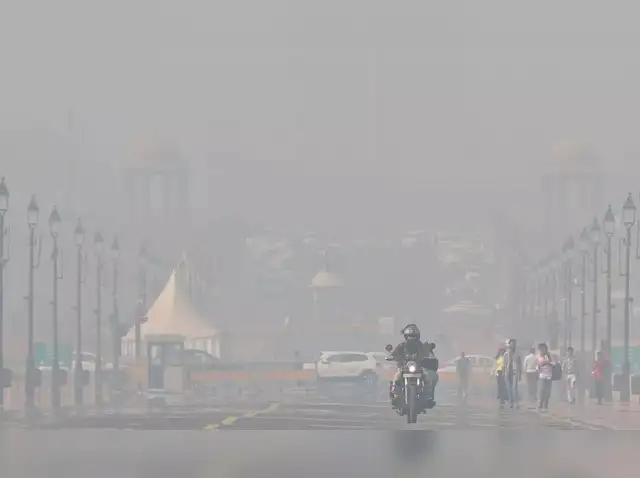

New Delhi: The strictest pollution control measures under the Graded Response Action Plan (GRAP-4) have been reimposed across Delhi-NCR after air quality deteriorated sharply on Saturday, with the Air Quality Index (AQI) inching close to the 450 mark, categorised as “Severe+”.
In a notification issued late Saturday, the Commission for Air Quality Management (CAQM) said Delhi’s AQI stood at 400 at 4 pm and climbed rapidly to 428 by 8 pm, driven by western disturbance, highly unfavourable meteorological conditions, and poor dispersal of pollutants.
“Keeping in view the prevailing trend of air quality and relevant factors, and in an effort to prevent further deterioration, the CAQM Sub-Committee on GRAP has unanimously decided to invoke all actions under Stage-IV of the extant GRAP (‘Severe+’ AQI) with immediate effect across the entire NCR as a proactive measure,” the commission said.
Understanding GRAP categories
Under the Graded Response Action Plan, air quality levels are classified as:
- Poor: AQI 201–300
- Very Poor: AQI 301–400
- Severe: AQI 401–450
- Severe+: AQI above 450
The current trend, officials warned, indicates a risk of AQI breaching the Severe+ threshold if conditions persist.
Key restrictions under GRAP-4
Several stringent measures will now come into force across Delhi-NCR:
- Ban on non-BS-VI vehicles:
Vehicles that are not BS-VI compliant, including petrol vehicles, and not registered in Delhi are prohibited from entering the capital. This restriction, first introduced in December 2025, has been reactivated. - Truck entry restricted:
Entry of non-essential trucks into Delhi is banned. However, trucks carrying essential goods or services, and those operating on cleaner fuels such as LNG, CNG, electric, or BS-VI diesel, are exempt. - Construction activities halted:
All construction and demolition activities are completely suspended, including major public infrastructure projects such as roads, highways, flyovers, overbridges, power transmission lines, and pipelines.
Measures to protect health and reduce exposure
To safeguard vulnerable populations, especially children and the elderly:
- Schools:
State governments in NCR and the Government of National Capital Territory of Delhi (GNCTD) may shift physical classes for students of Classes VI to IX and XI to online mode. Classes X and XII are generally exempted to avoid disruption to board exam preparations. - Offices and workplaces:
Public, municipal, and private offices are advised to operate with at least 50% staff working from home. Staggered office timings may also be introduced to ease peak-hour traffic congestion.
Possible emergency steps
As discretionary emergency measures, authorities may consider:
- Closure of colleges and higher educational institutions
- Suspension of non-essential commercial activities
- Implementation of odd-even vehicle rationing
- Work-from-home directives for central government employees, if deemed necessary
Officials said the situation will be reviewed daily, and further restrictions could be imposed if air quality worsens.