

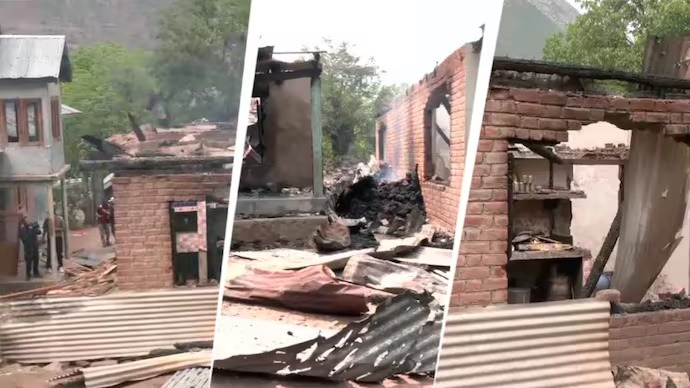

New Delhi: Fifteen civilians have lost their lives and 43 others were injured after Pakistan Army artillery shelling targeted border villages in Poonch and Tangdhar, Jammu and Kashmir, since Tuesday night, according to defence sources. This deadly escalation follows India’s precision military operation, “Operation Sindoor”, which targeted nine terrorist camps across Pakistan and Pakistan-occupied Jammu and Kashmir (PoJK).
The shelling from across the Line of Control caused widespread panic among civilians and damaged several homes and religious structures, including the Central Gurdwara Sri Guru Singh Sabha Sahib in Poonch, where at least three Gursikhs were killed.
Condemning the “inhuman attack” on the Gurdwara, Shiromani Akali Dal (SAD) president Sukhbir Singh Badal named the deceased as Bhai Amrik Singh Ji, a raagi Singh, Bhai Amarjeet Singh, and Bhai Ranjit Singh. He expressed solidarity with the victims’ families and demanded state recognition and compensation.
“We demand that the martyrs be honored and the bereaved families supported adequately. If our honor is challenged, we need no reminder to fulfill our patriotic duties,” Badal posted on X.
Punjab Chief Minister Bhagwant Mann also mourned the attack, confirming the additional death of Ruby Kaur, and stated that “targeting places of worship is deeply condemnable.”
“Where prayers are offered for all, such attacks are a grave affront. My prayers go out to the families enduring this pain,” Mann wrote.
In the aftermath of Operation Sindoor, Pakistan intensified ceasefire violations, hitting civilian zones. Visuals from affected villages in Poonch showed shattered window panes, cracked walls, and streets littered with debris.
Jammu and Kashmir Chief Minister Omar Abdullah convened an emergency meeting to assess border security and humanitarian response.
Operation Sindoor: A Coordinated Strike
Earlier in the day, the Ministry of Defence briefed the Union Cabinet on Operation Sindoor, stating that nine terror camps—including those in Bahawalpur, Muridke, Sialkot, and five in PoJK—were precisely targeted using air and ground assets from the Indian Army, Navy, and Air Force.
At the inauguration of 50 BRO infrastructure projects, Defence Minister Rajnath Singh lauded the forces for acting with “precision, alertness, and humanity.”
“Our jawans scripted history. They were sensitive to avoid any civilian harm,” Singh said, thanking PM Narendra Modi for backing the operation.
Foreign Secretary Vikram Misri said the Pahalgam terror attack, which killed 26 civilians including a Nepali national, was executed with “extreme barbarity,” including execution-style killings in front of families. Intelligence had also warned of more such attacks, necessitating pre-emptive and proportionate action, he said.
“Our actions were focused on dismantling terrorist infrastructure while avoiding civilian casualties,” Misri affirmed.
Wing Commander Vyomika Singh added that no civilian infrastructure was affected during the strikes, and Col Sofiya Qureshi showcased videos of the destruction of the terror sites.
India’s Operation Sindoor marks its most significant strike on Pakistani soil since the 1971 war, asserting New Delhi’s resolve to retaliate against cross-border terrorism while attempting to limit civilian harm.