

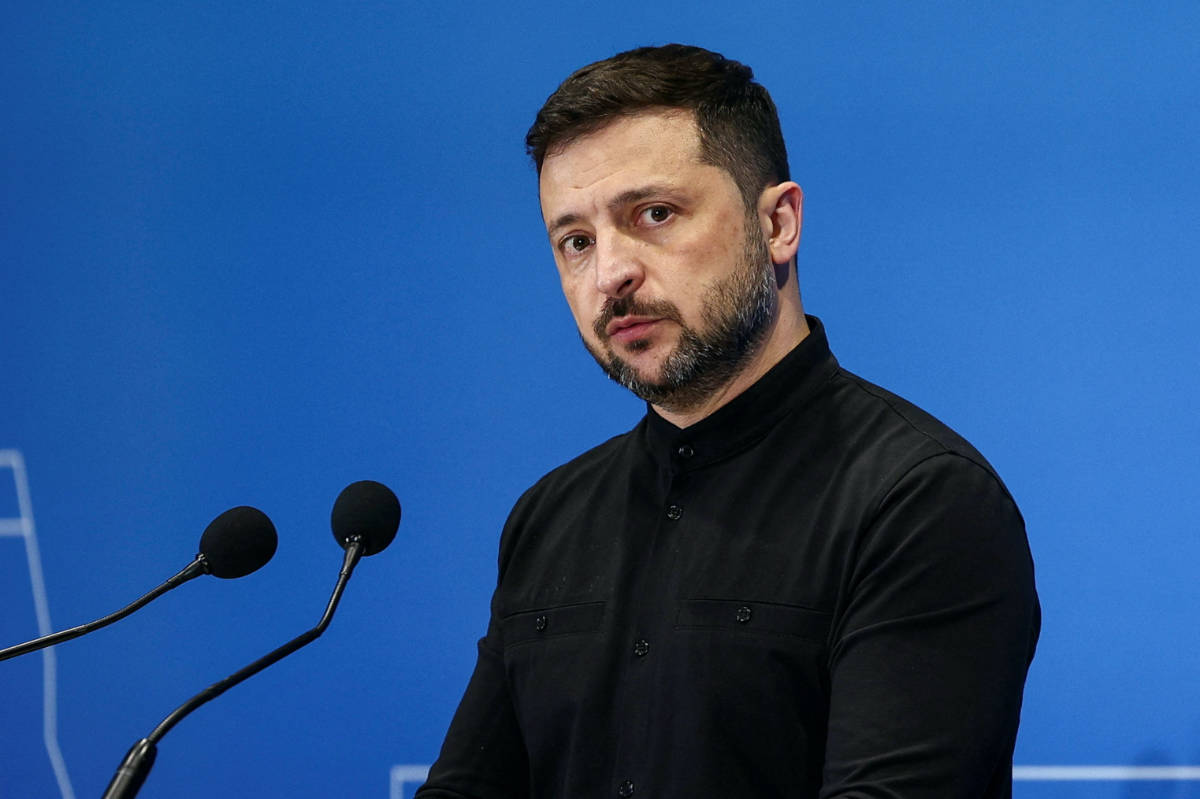

KYIV, Ukraine – Ukrainian President Volodymyr Zelenskiy on Wednesday vowed to retain the independence of the nation’s anti-corruption agencies, a significant concession following the first wartime street protests and rare rebukes from key European allies.
For a second consecutive day, thousands of citizens across Ukraine—from Kharkiv in the northeast to the capital Kyiv and Lviv in the west—took to the streets, demanding the reversal of a recently enacted law that curbed the independence of these crucial anti-graft bodies.
In his evening address to the nation on Wednesday, Zelenskiy acknowledged the public’s widespread discontent. “Of course, everyone has heard what people are saying these days… on social media, to each other, on the streets. It’s not falling on deaf ears,” Zelenskiy stated, adding that he would submit a new bill to make sure the rule of law and retain the independence of the anti-corruption agencies.
Thousands of people gathered for a second day of protests in central Kyiv, close to Zelenskiy’s office. In these unprecedented wartime demonstrations, youth, activists, and war veterans chanted ‘Shame’ and ‘Veto the Law’.
“It’s like a knife in the back, to be honest,” Maryna Mykhalchuk, 26, who has friends killed in the war and plans to join the army soon, told Reuters, expressing the deep betrayal felt by many.
Opposition lawmakers and European officials had also vehemently called for the reversal of the controversial law, which Zelenskiy had signed overnight. The law granted the Prosecutor General, an appointee of Zelenskiy, more power over two investigative anti-corruption agencies: the National Anti-Corruption Bureau (NABU) and the Specialised Anti-Corruption Prosecutor’s Office (SAPO). This legislation was controversially rushed through parliament on Tuesday, just a day after the security services arrested two anti-corruption officials for suspected Russian ties.
In a joint statement, both NABU and SAPO asserted their desire for their independence to be restored through new legislation. Parliament is now expected to hold an emergency session next week to consider the new draft bill from Zelenskiy’s office, according to several lawmakers.
Strongest Criticism Since the War Began
The recently enacted law prompted some of Ukraine’s European allies to deliver their strongest criticism of Zelenskiy’s government since Russia’s full-scale invasion in February 2022. European Commission President Ursula von der Leyen reportedly expressed her strong concern to Zelenskiy and requested an explanation, as confirmed by her spokesman.
Critics of the law argue that the government appeared to be attempting to rein in anti-corruption agencies to protect certain officials. After decades of endemic corruption in Ukraine, cleaning up its government has been emphasized as a key condition for the country to join the European Union, access billions of dollars in foreign aid, and integrate more broadly with the West.
The issue carries significant risk, potentially antagonizing Kyiv’s most loyal allies at a time when Ukraine is also striving to smooth over its relationship with the administration of U.S. President Donald Trump, who has frequently criticized Zelenskiy.
“Ukraine’s anti-corruption institutions are vital to its reform path. Restricting them would be a significant setback,” Dutch Foreign Minister Caspar Veldkamp said in a post on X. Benjamin Haddad, France’s European Affairs minister, also stated that it was not too late to reverse the decision.
Ukrainian political analysts warned that the controversial legislation risked undermining society’s trust in Zelenskiy during a critical stage of the ongoing war against Russia. Fierce fighting continues along more than 1,000 kilometers of the frontline, with Russian troops making grinding advances in the east and stepping up near-daily drone attacks on Ukrainian cities.
Hundreds of protesters, some clad in military uniforms, in the city of Zaporizhzhia, close to the frontline in the southeast, demanded the overturning of the law with chants of “Ukraine is not Russia.” Similar rallies took place in other major cities across the country.
Valerii Pekar, a Kyiv-based analyst, emphasized the public’s European aspirations as vital to sustaining the war effort, stating on Facebook: “Only democracy and the European choice give us a chance to win.”