

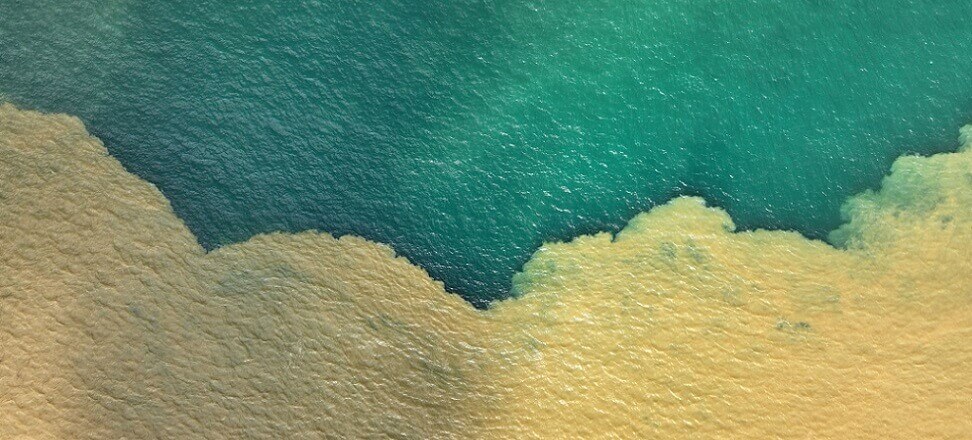

In a world where natural forces often blend seamlessly, there are a few places that defy expectations. One of the most stunning examples of this phenomenon can be found near the Gulf of Alaska, where the waters of two mighty oceans, the Pacific and the Atlantic, meet but appear to refuse to mix. The sight, often captured in viral videos and photographs, shows a distinct “border” where one side of the water is a deep, clear blue, and the other is a lighter, almost muddy gray.
This seemingly magical boundary is a real and fascinating display of a phenomenon governed by fundamental principles of physics and chemistry. It’s not the two entire oceans that don’t mix, but rather, the confluence of two distinct types of water with vastly different properties.
The Science Behind the Separation
The separation isn’t a result of the Atlantic and Pacific oceans as a whole, but rather the meeting of freshwater glacial meltwater and the saltwater of the Gulf of Alaska. The rivers that feed into the Gulf of Alaska, such as the Copper River, are fed by massive, eroding glaciers. As these glaciers melt, they carry a huge amount of sediment, including a fine clay-like silt often referred to as “glacial flour.” This sediment gives the glacial meltwater its cloudy, light-colored appearance.
When this sediment-laden, less-dense freshwater meets the saltier, denser ocean water, a visible boundary forms. This boundary is known as a halocline, which is a layer of water where the salinity changes rapidly with depth.
Key Factors at Play:
- Salinity and Density Differences: The primary reason the waters resist mixing is their different densities, which are determined by their salinity and temperature. Saltier water is denser and tends to sink, while less-salty freshwater is lighter and floats on top. In this case, the freshwater from the glaciers is much less dense than the saltwater of the Pacific Ocean. This stark difference in density creates a visible barrier.
- Lack of Turbulence: When the two water masses meet, instead of violent currents that would quickly mix them, the density differences prevent the waters from churning. This creates a sharp, almost perfectly straight line at the surface, which is maintained over long distances.
- Sediment Content: The color difference is due to the presence of sediment in the glacial runoff. The glacial meltwater is filled with a high concentration of silt and soil, making it appear cloudy and light. The ocean water, on the other hand, is deep and clear, with a low sediment load, giving it its characteristic dark blue hue. The lack of mixing means the sediments remain on their respective sides of the halocline.
A Larger Phenomenon
The process seen in the Gulf of Alaska is not unique. It’s a prime example of a broader phenomenon that occurs in many places around the world where bodies of water with different properties meet. For instance, the Strait of Gibraltar, where the highly saline Mediterranean Sea meets the Atlantic Ocean, and the confluence of the Rio Negro and the Amazon River, are other places where visible boundaries form. While the water masses do eventually mix over time, the process is very slow, and the visible boundary, or halocline, can persist for a long time, creating a stunning and educational natural sight.