

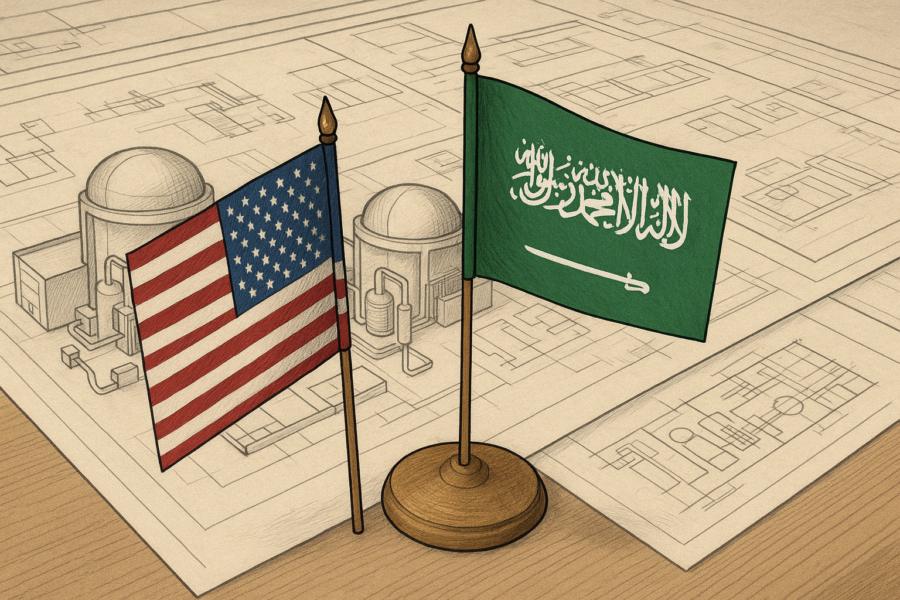

The United States has completed negotiations with Saudi Arabia on a long-sought nuclear technology-sharing arrangement, potentially clearing the path for American companies to build reactors in the kingdom. The breakthrough was announced after Energy Secretary Chris Wright and his Saudi counterpart signed a joint declaration confirming that the technical talks had concluded. The announcement came shortly after Crown Prince Mohammed bin Salman’s visit to the White House on Tuesday, the Trump administration said.
However, a formal 123 Agreement under the US Atomic Energy Act — a mandatory framework that typically includes stringent non-proliferation commitments — has not yet been finalized, a spokesperson for the US Energy Department confirmed. Without a signed 123 Agreement, nuclear cooperation cannot formally move forward.
If completed, the agreement could significantly revive the US nuclear energy sector, offering major opportunities to companies such as Westinghouse Electric Co. and other US-based firms eager to build reactors or export nuclear technology to Saudi Arabia. But the development has already heightened anxiety among non-proliferation experts and lawmakers who fear the misuse of weapons-grade material.
The absence of a 123 Agreement also raises important regional implications. Granting Saudi Arabia access to the full nuclear fuel cycle — including activities such as uranium enrichment — could prompt countries like Iran and the United Arab Emirates to demand the same rights.
International Atomic Energy Agency (IAEA) Director General Rafael Mariano Grossi confirmed that the negotiated framework “does include fuel cycle activities,” following a phone call with Saudi Arabia’s Energy Minister Prince Abdulaziz bin Salman on Wednesday morning. He added that the IAEA has not been informed whether the final agreement will include the required 123 safeguards.
The White House and Energy Department did not immediately clarify whether the final deal would include the so-called “gold standard” — a provision that prohibits uranium enrichment and reprocessing of spent fuel. Saudi Arabia has historically resisted such restrictions.
In a statement, Secretary Wright said, “Together, with bilateral safeguard agreements, we want to grow our partnership, bring American nuclear technology to Saudi Arabia, and keep a firm commitment to nonproliferation.”
According to a White House fact sheet, the declaration signed on Tuesday “builds the legal foundation for a decades-long, multi-billion-dollar nuclear energy partnership with the Kingdom; confirms that the United States and American companies will be the Kingdom’s civil nuclear cooperation partners of choice; and ensures that all cooperation will be conducted in a manner consistent with strong nonproliferation standards.”
However, skepticism remains — including from Israel. Ahead of the Saudi crown prince’s visit, Israeli Energy Minister Eli Cohen told Channel 14 TV that he believed the deal could pose long-term security risks. “Israel should be opposed, because it would bring about a situation where there will constantly have to be monitoring and oversight, to check whether the nuclear civilian project is sliding toward the military side,” Cohen said. “This will constantly have to be checked.”
Non-proliferation watchdogs also pointed to the conspicuous absence of a finalized 123 Agreement in the announcements so far. Henry Sokolski, executive director of the Nonproliferation Policy Education Center, said, “They may be close to reaching a formal 123 US nuclear cooperative agreement, but if they actually had it, you would think they would mention how they dealt with the ‘E word’ — the enrichment of uranium — and whether or not the US will help the Kingdom engage in this nuclear bomb-sensitive activity.”