

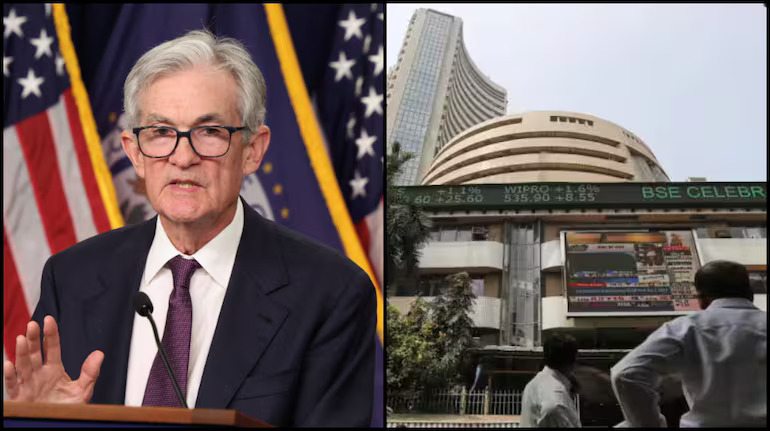

On Wednesday, the US Federal Reserve dropped its benchmark interest rate by 25 basis points, lowering the target range down to 4-4.25%. This action has been closely monitored by financial markets from around the world. This is the first time this year that the US central bank has lowered interest rates, and the effects are already being felt in markets throughout the world, including India.
Jerome Powell, the head of the Federal Reserve, said that the decision was made because the labor market was “wobbling” and there were more dangers to jobs. Powell’s comment signals that the central bank is changing its focus to putting economic growth first, even though he admits that inflation is still a problem.
This is a big deal for the Indian stock market. Now, people in the market and financial specialists are eagerly waiting to see how this choice would affect international investment and domestic monetary policy. Asian stocks, especially IT stocks, saw a big bounce on the day of the announcement, which is a hint of a good quick reaction.
The Indian market could be greatly affected by the US rate drop. Deepak Agarwal, CIO–Debt at Kotak Mutual Fund, is one of many experts who think that the Fed’s decision gives the Reserve Bank of India (RBI) a chance to think about cutting rates sooner than planned.
Agarwal said, “It looks like the Fed is putting growth first.” He also said that the FOMC (Federal Open Market Committee) has hinted that there may be more rate decreases in the next year. Agarwal thinks that this tendency, along with decreased inflation because of recent GST cuts in India, could make it more likely that the RBI will drop rates as soon as October 2025.
The Indian economy would be greatly affected by a rate cut from the RBI. It would probably make things more liquid and give the Indian stock market a much-needed lift as it tries to get back to its prior highs. A weaker US dollar, which is generally the effect of a Fed rate cut, might also bring more foreign institutional investment (FII) into emerging economies like India in the coming months.
Some experts think that the rate drop was already taken into account in market prices, but most people are happy about it. If the US currency gets weaker and global yields go down, Indian assets might become more appealing to foreign investors. This could bring back some of the FII outflows that happened earlier this year. This might be a very important safety net for the Indian markets as they deal with a complicated global economy.