

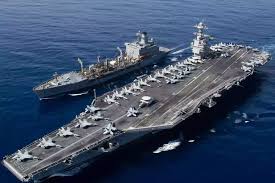

The USS Gerald R. Ford, the world’s largest aircraft carrier, entered Latin American waters on Tuesday under the control of the US Naval Forces Southern Command, significantly escalating tensions in the region. The deployment marks a major step in what the Donald Trump administration describes as a campaign against drug trafficking, but which Venezuela claims is a prelude to war.
According to a statement from the Southern Command, the deployment of the USS Gerald R. Ford strike group aims to enhance US operations in “detecting, monitoring, and disrupting illicit actors and activities that compromise the safety and prosperity of the United States homeland and our security in the Western Hemisphere.”
Pentagon spokesman Sean Parnell said the move would bolster the US’s ability to counter threats in the Caribbean and Latin America.
Venezuela Warns of Full-Scale Conflict
The deployment comes as President Nicolás Maduro announced a “massive nationwide military response,” accusing Washington of “fabricating a war” under the pretext of combating narcotics.
“If we as a republic, as a people, go into an armed struggle in order to defend the sacred legacy of our liberators, we are ready to win,” Maduro declared on Tuesday.
According to Venezuelan Defense Minister Vladimir Padrino, around 200,000 troops have been mobilized in land, sea, air, and missile units, alongside civilian militias, in response to what Caracas calls “imperial threats.”
“They are murdering defenseless people, whether or not they are drug traffickers, executing them without due process,” Padrino alleged, referring to US military strikes in regional waters.
Despite the claims of large-scale mobilization, no significant military activity was reported in Caracas. Defense experts say Venezuela’s outdated arsenal and limited training would leave it at a serious disadvantage in any confrontation with the United States.
US Denies Regime Change Motive
The Trump administration has denied any intent to overthrow the Venezuelan government, asserting that the operation targets drug cartels in the Caribbean and eastern Pacific.
Since early September, US forces have reportedly conducted strikes on about 20 vessels, killing at least 76 people, according to official data. However, Washington has not provided evidence that these vessels were involved in smuggling operations. Human rights observers have warned that the attacks could constitute extrajudicial killings, even if the targets were suspected traffickers.
Tensions spiked further after Colombian President Gustavo Petro suspended his country’s intelligence-sharing agreement with Washington. “This pause will remain in force as long as the missile attacks on boats continue,” Petro posted on X.
Russia and UK React
Moscow, a key ally of Caracas, swiftly condemned the US operations. Russian Foreign Minister Sergei Lavrov called the strikes “unacceptable,” saying, “This is how lawless countries act — those who consider themselves above international law — under the pretext of fighting drugs.”
Maduro has long relied on Russian political and economic backing, a relationship that now deepens the geopolitical rift as US-Russia ties continue to deteriorate amid ongoing tensions over the Ukraine war.
Meanwhile, the United Kingdom declined to comment on reports that it has stopped sharing intelligence with the US about suspected drug-smuggling vessels in the Caribbean. “We don’t comment on security or intelligence matters,” a spokesman for Prime Minister Keir Starmer told reporters, reaffirming that the US remains Britain’s “closest partner on defense, security, and intelligence.”
Analysis: Rising Tensions in the Caribbean
The USS Gerald R. Ford’s presence — coupled with the deployment of F-35 stealth fighters to Puerto Rico and six US Navy ships in the Caribbean — has fueled concerns of a potential military standoff between Washington and Caracas.
While the US insists its mission is limited to counter-narcotics, Venezuela’s government fears it could evolve into a regime-change operation, recalling Washington’s history of interventions in Latin America.
With both nations ramping up rhetoric and military preparedness, the region finds itself on edge — and the risk of miscalculation is growing by the day.