

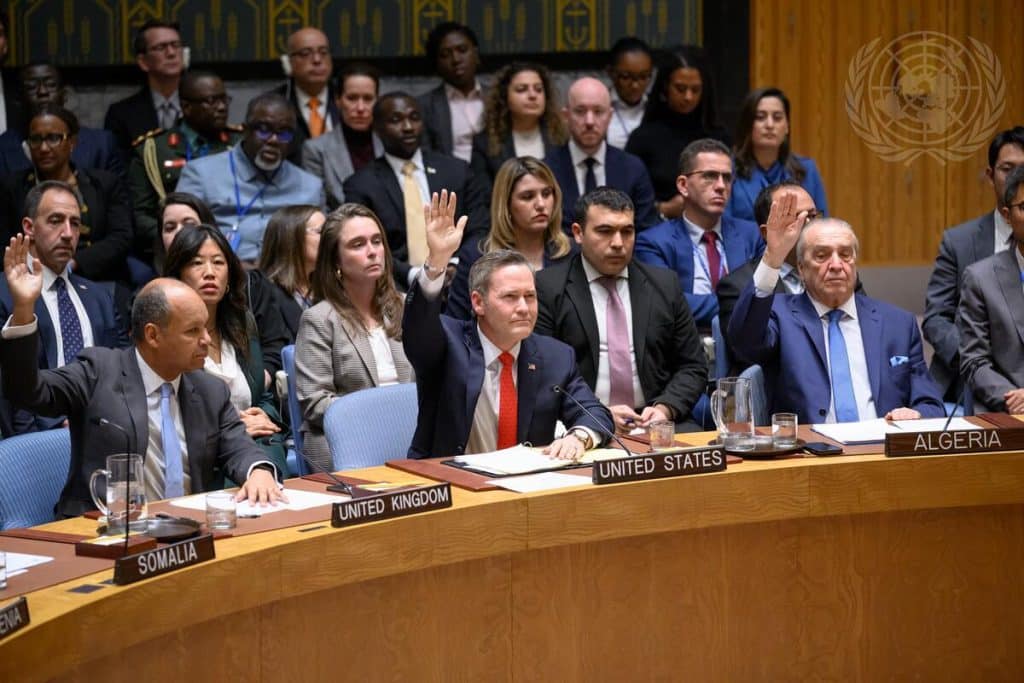

The UN Security Council on Monday voted to adopt a US-drafted resolution that officially endorses President Donald Trump’s plan to end the two-year war in Gaza. Crucially, the resolution authorizes the deployment of an international stabilization force (ISF) for the Palestinian enclave.
The resolution is considered vital for legitimizing a transitional governance body known as the Board of Peace and reassuring member states considering contributing troops to Gaza. Israel and the Palestinian militant group Hamas had already agreed last month to the first phase of Trump’s 20-point plan, which included a ceasefire and a hostage-release deal.
Key Elements of the UN Resolution
The adopted text outlines the framework for Gaza’s immediate future:
- Board of Peace: The resolution invites UN member states to participate in the Trump-chaired Board of Peace, envisioned as the transitional authority that will oversee the reconstruction and economic recovery of Gaza.
- International Stabilization Force (ISF): The resolution authorizes the ISF, which will be tasked with the demilitarization of Gaza. This process includes the decommissioning of weapons and the destruction of military infrastructure.
- Pathway to Statehood: The resolution includes a controversial reference to a future possibility of statehood for Palestinians, stating that “conditions may finally be in place for a credible pathway to Palestinian self-determination and statehood” once the Palestinian Authority completes a reform program and Gaza’s redevelopment is advanced.
Hamas Rejects Disarmament and International Guardianship
In a statement issued immediately following the vote, the Palestinian militant group Hamas reiterated its refusal to disarm. The group argued that its fight against Israel constitutes legitimate resistance, setting up a potential confrontation with the newly authorized international stabilization force.
Hamas condemned the resolution, stating: “The resolution imposes an international guardianship mechanism on the Gaza Strip, which our people and their factions reject.”
Global Reaction and Abstentions
The US ambassador to the UN, Mike Waltz, championed the resolution before the council, stating that it “charts a possible pathway for Palestinian self-determination… where rockets will give way to olive branches.” He added that the plan “dismantles Hamas’ grip, it ensures Gaza rises free from terror’s shadow, prosperous and secure.”
- UNSC Vote: The resolution passed as two permanent members, Russia and China, chose to abstain from the vote, despite Russia having previously signaled potential opposition.
- Russian and Chinese Concerns: Russian ambassador Vasily Nebenzya complained that the resolution gives “complete control over the Gaza Strip to the Board of Peace and the ISF,” whose modalities remain largely unknown, effectively giving a “blessing to a U.S. initiative” without a clear role for the UN.
- Palestinian Authority Support: The Palestinian Authority (PA) issued a statement welcoming the resolution and declared its readiness to participate in its implementation. Diplomats noted that the PA’s endorsement last week was crucial in preventing Russia from casting a veto.
President Trump celebrated the adoption on social media, calling it “a moment of true Historic proportion” and promising “many more exciting announcements” regarding the Board of Peace members in the coming weeks.
Israel’s Opposition to Statehood Clause
In Israel, the resolution has proven controversial due to its mention of a “political horizon for peaceful and prosperous coexistence,” including the possibility of Palestinian statehood. Prime Minister Benjamin Netanyahu, facing pressure from right-wing members of his government, stated on Sunday that Israel remains opposed to a Palestinian state and vowed to demilitarize Gaza “the easy way or the hard way.”