

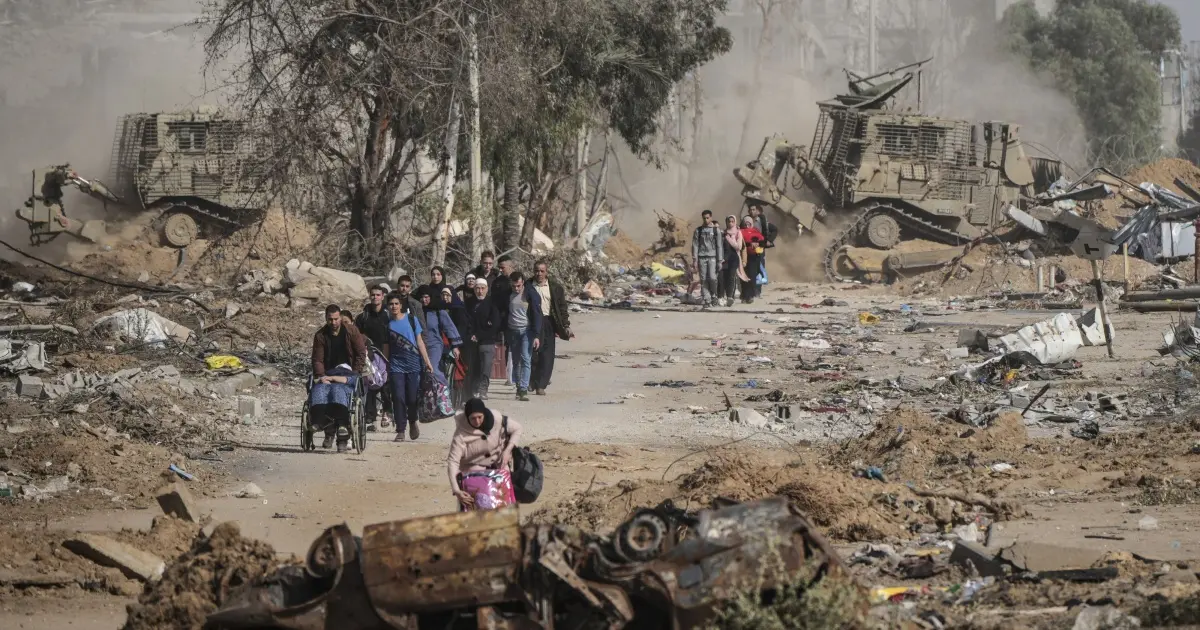

The human cost and physical destruction inflicted upon the Gaza Strip by the ongoing Israel-Hamas war have reached levels described as unprecedented, transforming the territory’s 365 square kilometers (140 square miles) into a catastrophic humanitarian zone. While numbers alone fail to fully capture the despair, statistics released by various international bodies and local authorities paint a stark picture of the devastation endured by the 2.1 million Palestinians living there.
A Population in Crisis: Casualties and Displacement
The sheer scale of the casualties highlights the intensity of the conflict:
- Casualty Rate: Roughly 11% of Gaza’s pre-war population has been either killed or injured in Israeli strikes. Specifically, one out of every 10 people in Gaza has become a casualty.
- Death Toll: Israel’s campaign has killed more than 67,000 Palestinians and wounded nearly 170,000, according to Gaza’s Health Ministry (which does not distinguish between combatants and civilians but whose figures are viewed as a reliable estimate by the U.N. and many experts). Over 40,000 of the wounded have life-altering injuries, according to the World Health Organization (WHO).
- Missing and Buried: The death toll does not include the thousands of people believed to be buried under the rubble, a result of the heavy bombardment that has seen Israeli airstrikes kill entire families in their homes.
- Displacement: Nearly the entire population is displaced, with nine out of every 10 people uprooted. Countless families have been displaced multiple times, moving between destroyed apartments and squalid tent camps now sprawling across the south.
- Vulnerable Groups: Four out of every 100 children have lost one or both parents. The war is also officially the deadliest conflict in history for journalists, health workers, and U.N. aid workers.
The conflict began on October 7, 2023, when Hamas militants launched a surprise attack on Israel, killing some 1,200 people, mainly civilians, and taking 251 hostages back to Gaza. Israel’s stated objective is to annihilate Hamas and free the remaining hostages. Israel says 48 hostages remain in Gaza, about 20 of whom the government believes are alive. Israel attributes the high civilian toll to Hamas’s use of residential areas, arguing the population is being used as human shields.
Infrastructure Annihilated and Famine Confirmed
The physical damage has made large parts of the strip virtually uninhabitable:
- Building Destruction: Eight out of every 10 buildings that stood in Gaza pre-war are either damaged or flattened. Imagery from the U.N.’s Satellite Center indicates that at least 102,067 buildings have been destroyed, including grade schools, universities, medical clinics, and mosques.
- Housing Loss: Nine out of every 10 homes are wrecked.
- Territory Control: The Israeli military has gained control of the vast majority of Gaza, effectively pushing most of the Palestinian population into a small zone along the southern coast. Israeli forces have flattened entire neighborhoods and carved new roads across the territory.
- Agricultural Loss: Eight out of every 10 acres of cropland are razed, stripping the strip of agricultural capacity.
The lack of access to necessities has spiraled into a food catastrophe:
- Starvation: At least three out of every 10 people have not eaten for days.
- Famine Declaration: After months of warnings, the world’s leading authority on food crises confirmed in August 2025 that famine had taken hold in Gaza City. Hundreds of Palestinians now jostle for basic food aid, and aid groups report a surge in malnutrition.
With the war now entering its third year, and Israeli forces threatening the heart of Gaza City, a new American peace plan is reportedly on the table, even as the humanitarian crisis deepens.