

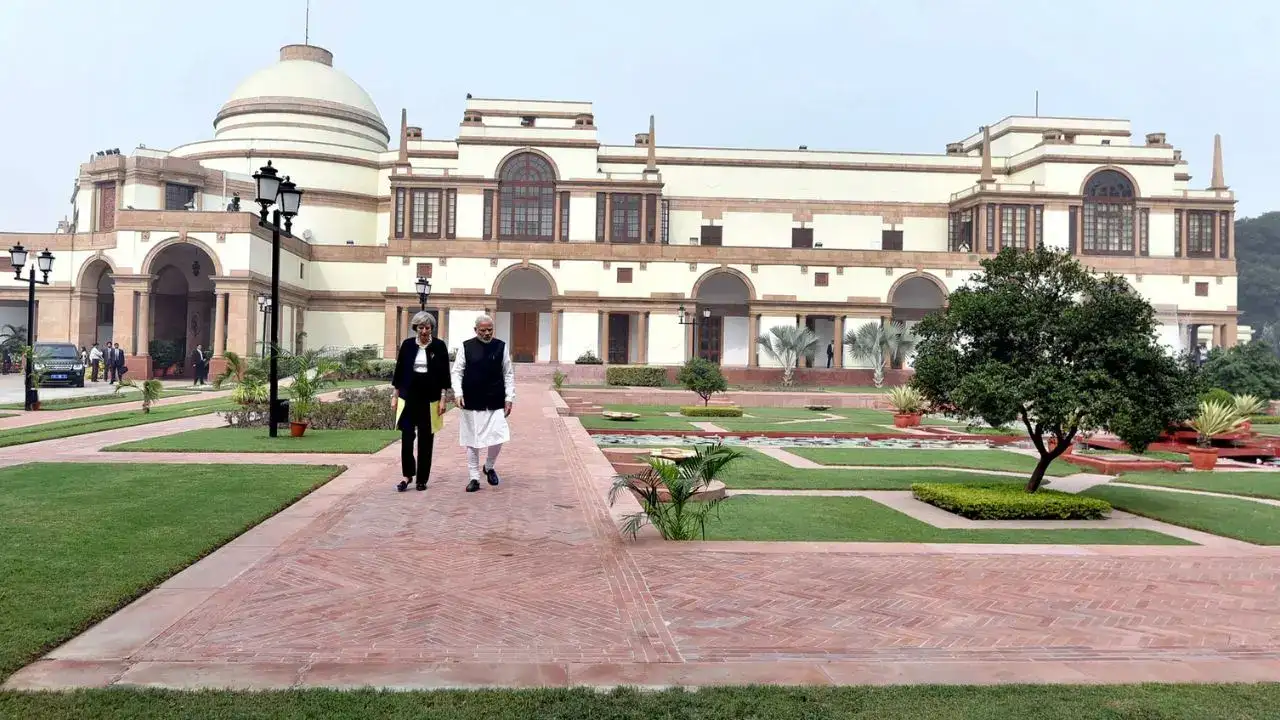

Amidst Russian President Vladimir Putin’s high-profile visit to India, Prime Minister Narendra Modi is hosting him at the stately Hyderabad House, one of India’s most distinguished diplomatic venues. Located near India Gate, this majestic structure routinely serves as the ceremonial backdrop for high-profile state visits and official banquets.
Origins and Opulent Design
The origins of Hyderabad House trace back nearly a century to pre-Independence India.
- The Owner: In 1926, Mir Osman Ali Khan, the seventh Nizam of Hyderabad, who was once hailed as the world’s richest man, acquired just over eight acres of land in the capital. As a member of the Chamber of Princes, the Nizam required a stately Delhi residence for meetings convened by the British authorities, a common practice among other princely families who built residences like Baroda House and Patiala House nearby.
- The Architect: The Nizam commissioned renowned architect Edwin Lutyens, who also designed the then Viceroy’s House (now Rashtrapati Bhavan). The resulting design was a majestic structure, modeled partly on the Viceroy’s House, blending the neo-classical style with touches of Roman design.
- The Cost: The palace’s construction came with a monumental price tag. Contemporary estimates suggest the palace cost around ₹50 lakh in pre-Independence India. According to a Times Now report, this staggering sum is equivalent to an estimated ₹378 crore in today’s terms. Although only ₹26 lakh was initially allocated, the Nizam willingly absorbed the nearly doubled final expenditure.
Architectural Grandeur and Lavish Interiors
The mansion was famously designed in the form of a butterfly and originally featured 36 rooms, including four reserved for the zanana (the section for wives and female servants).
Key features highlighting its grandeur include:
- A massive central dome and a circular entry hall.
- Manicured quadrangle lawns and sweeping staircases.
- A fusion of European forms with Mughal detailing.
- Luxurious Fittings: The structure featured Burmese teak, electrical fixtures imported from New York, and luxury furnishings modeled on London hotel suites.
- Fine Art and Dining: Lahore’s celebrated painter Abdul Rahman Chughtai was commissioned to create 30 artworks for ₹12,000. The interiors were adorned with handwoven carpets from Iraq and Persia, and the massive dining hall was designed to host up to 500 guests.
For insurance, records cited by The Hindu show the building was insured for ₹12 lakh and its furniture for another ₹6 lakh.
From Princely Home to Diplomatic Powerhouse
Despite the scale and splendor, the Nizam reportedly never felt truly at home in Hyderabad House, often finding its architecture too Western. His visits remained infrequent. His last major function there was in 1954, hosting dignitaries including President Rajendra Prasad, Jawaharlal Nehru, and Eleanor Roosevelt.
The Indian government took the property on lease in 1954. Today, the Ministry of External Affairs oversees its use as a primary venue for high-profile diplomatic events, while the India Tourism Development Corporation manages its upkeep and hospitality services, solidifying its role as a cornerstone of India’s diplomatic infrastructure.