

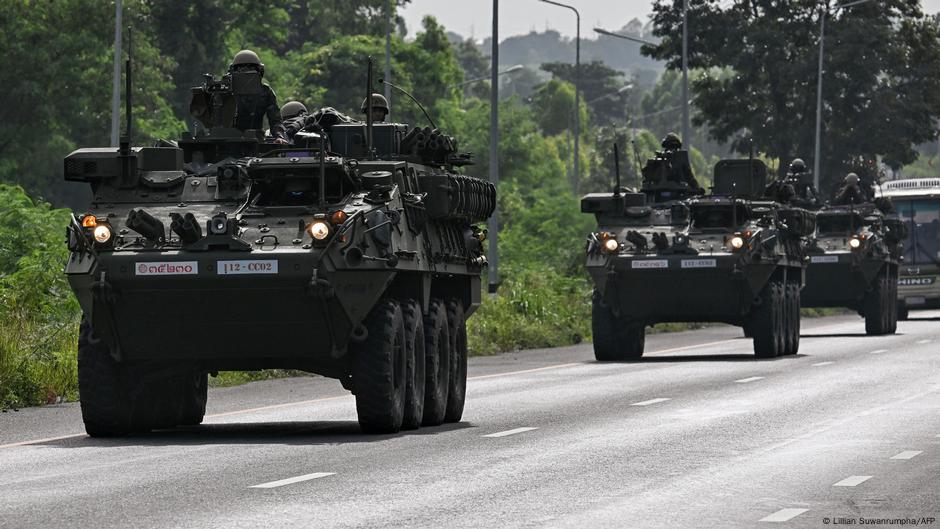

Phnom Penh, Cambodia / Bangkok, Thailand – The United Nations Security Council (UNSC) has scheduled an urgent private meeting for Saturday to address the intensifying cross-border fighting between Cambodia and Thailand, following requests from both Southeast Asian nations. The renewed conflict, which erupted on Thursday, has seen both sides exchange accusations of initiating hostilities, leading to a humanitarian crisis with thousands displaced.
Cambodian Prime Minister Hun Manet’s request prompted the 15-member UN body to convene under the “Threats to international peace and security” agenda item. Both Thailand and Cambodia are expected to participate in the meeting.
Conflicting Accounts of How Clashes Began
Thailand asserts that the clashes began on Thursday when Cambodia’s military deployed drones to conduct surveillance of Thai troops near the border. In contrast, Cambodia alleges that Thai soldiers initiated the conflict by violating a prior agreement.
Cambodia has accused Thailand of launching “unprovoked, premeditated and deliberate attacks on Cambodian positions along the border areas, including Tamone Thom Temple, Ta Krabey Temple and Mom Bei, in the provinces of Preah Vihear and Oddar Meanchey.” Phnom Penh also refuted Thailand’s claims about new landmines, arguing that Thai personnel “had deviated from the patrol routes previously coordinated between the two countries and created a new path through Cambodian territories, known to be officially documented mine-fields.”
Meanwhile, Thailand has officially submitted a letter to the UNSC, presenting its evidence that Cambodia initiated the armed conflict. The country’s Foreign Affairs Ministry spokesperson firmly rejected Cambodia’s accusation of violating its sovereignty, stating it was “completely contrary to the facts.” Thailand maintains that the landmines that injured its soldiers on July 16 and July 23 were newly planted. Bangkok further alleges that Cambodian soldiers were the first to open fire on July 24, targeting a Thai military base in Surin Province, after which Cambodia launched “indiscriminate attacks on Thai territory across four provinces of Buriram, Surin, Si Sa Ket and Ubon Ratchathani.”
Ceasefire Attempts and International Concern
Malaysian Prime Minister Anwar Ibrahim, who holds the rotating chair of the Association of Southeast Asian Nations (ASEAN), offered to mediate the conflict. Cambodian Prime Minister Hun Manet stated on Facebook that Thailand had initially agreed to a ceasefire starting from midnight on July 24, following Ibrahim’s proposal. However, Hun Manet later claimed that “just one hour after the phone conversation with the ASEAN chair, Thailand retracted its position.”
Thailand has confirmed its acceptance in principle of ASEAN’s mediation offer, but insists that Cambodia must first demonstrate a clear commitment to de-escalation. The Royal Thai Army has also vehemently rejected Cambodian claims of using F-16 fighter jets to attack civilian areas, labeling such reports as “distorted news.”
The escalating violence has led to significant displacement, with more than 130,000 people reportedly evacuated from conflict areas in Thailand, according to its health ministry.
The international community has voiced grave concern, with the United States, China, and Japan urging de-escalation. France has called upon both Cambodia and Thailand to immediately cease clashes and resolve the dispute through international law.
Decades-Long Border Dispute and Historical Flashpoints
The ongoing conflict stems from a decades-long disagreement over the jurisdiction of various non-demarcated areas along the 800-kilometer shared land border between Cambodia and Thailand. A central and frequently volatile point of contention has been the competing claims of ownership over the ancient Hindu temples of Prasat Ta Muen Thom and Preah Vihear, which are situated on the Dangrek Mountains, forming a natural border.
The Preah Vihear temple, a UNESCO World Heritage site, has been at the heart of severe past clashes. In 2011, fighting near the temple resulted in at least 16 deaths and prompted a UN Security Council meeting.
Recent tensions were exacerbated by incidents on July 16 and July 23, where Thai soldiers patrolling the border were injured by landmines, with one soldier losing a leg. These incidents led to Cambodia and Thailand recalling their respective ambassadors and closing numerous border crossings, setting the stage for the current military escalation.