

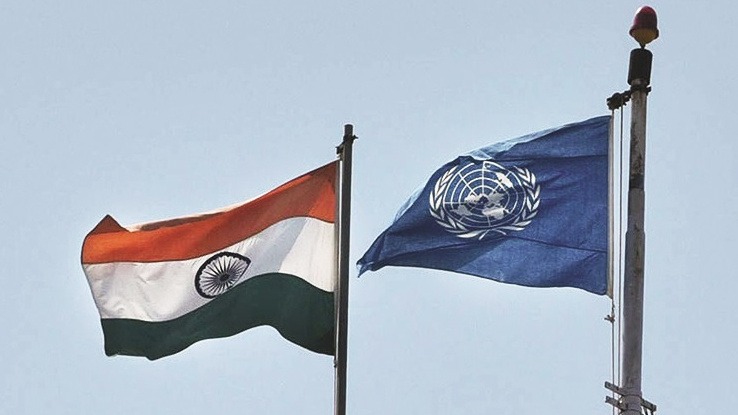

New York [US]: Top United Nations counter-terrorism officials met with a delegation from the Government of India to strengthen cooperation on countering terrorist misuse of emerging technologies, following the April 22 Pahalgam terror attack and India’s subsequent launch of Operation Sindoor.
The meeting involved Vladimir Voronkov, United Nations Under-Secretary-General for the Office of Counter-Terrorism (UNOCT), and Natalia Gherman, Assistant Secretary-General and head of the Counter-Terrorism Committee Executive Directorate (CTED). Both UN officials expressed condolences for the victims of the Pahalgam attack, which left 26 dead and many injured.
Focus on Emerging Tech, Unmanned Systems, and Fintech Risks
The discussions, according to a UN spokesperson, emphasized implementation of the 2022 Delhi Declaration, adopted under India’s chairmanship of the UN Counter-Terrorism Committee. Key points included:
- Countering the use of unmanned aircraft systems (drones) by terrorist groups
- Addressing the misuse of emerging financial technologies (e.g., crypto assets, digital wallets) for terror financing
- Strengthening non-binding guiding principles on these emerging threats, with CTED’s technical support
The meeting underlined the urgency of global regulatory cooperation to prevent non-state actors from exploiting new technologies for violent purposes.
Building Capacity, Preventing Radicalization
India and the UN reaffirmed their commitment to joint technical capacity-building efforts led by UNOCT, including:
- Cybersecurity and cyber hygiene training programs
- Tracking and stopping terrorist travel across borders
- Support for victims of terrorism
- Disrupting and tracing terror financing networks
These initiatives align with the UN Global Counter-Terrorism Strategy and Security Council resolutions that guide international efforts against terrorism.
Background: Operation Sindoor and Regional Escalation
The meeting comes amid heightened regional tensions following India’s Operation Sindoor, launched in response to the Pahalgam terror attack. On May 7, Indian Armed Forces carried out precision strikes on terrorist infrastructure in Pakistan and Pakistan-occupied Jammu and Kashmir (PoJK), eliminating over 100 militants linked to Jaish-e-Mohammed (JeM), Lashkar-e-Taiba (LeT), and Hizbul Mujahideen (HM).
Pakistan retaliated with cross-border shelling and drone activity along the Line of Control. In a measured counter-response, India targeted Pakistani air defense infrastructure, including radar and communications facilities.
By May 10, India and Pakistan reached an understanding on cessation of hostilities, although the situation remains fragile.
UN Applauds India’s Role in Global Counter-Terrorism Framework
Both UNOCT and CTED commended India’s contributions to multilateral counter-terrorism efforts, especially as a technical and financial partner in key initiatives. India has consistently advocated for stronger international frameworks to address state-sponsored terrorism and new-generation threats.