


New Delhi / Davos:
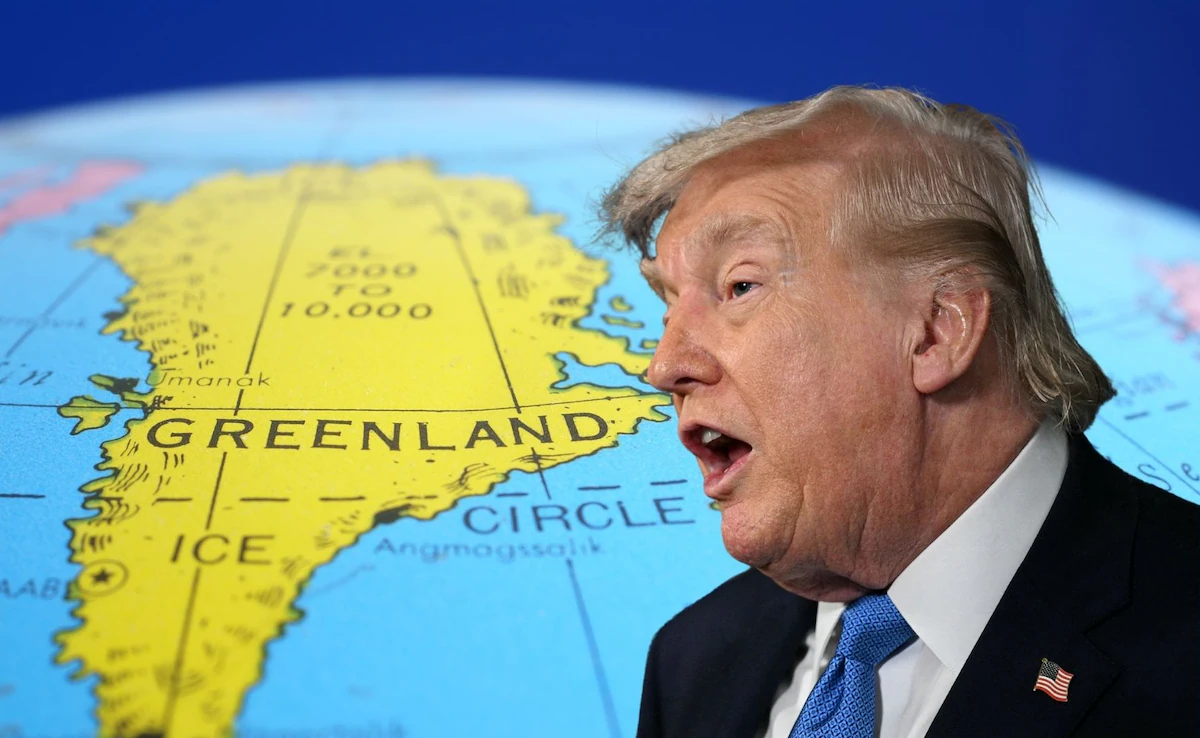
Speaking at the World Economic Forum in Davos on Wednesday, US President Donald Trump once again floated his long-standing interest in acquiring Greenland, telling an audience of global leaders that while Washington would not use military force, its strategic interest in the Arctic island was “non-negotiable”.
To justify his stance, Trump invoked World War II history, claiming the United States had “saved Greenland” after Nazi Germany occupied Denmark, preventing America’s enemies from gaining a foothold in the Western Hemisphere.
That account is partly true — but deeply incomplete.
What Trump Gets Right — And What He Leaves Out
After Nazi forces occupied Denmark in April 1940, the United States did move swiftly to secure Greenland, establishing military installations that still exist today in reduced form. However, Greenland was never owned by the US, nor was it later “returned” to Denmark, as Trump’s remarks implied.
More importantly, Trump’s narrative omits a crucial strategic reality: America’s wartime presence in Greenland was not an act of pure altruism. It was a calculated exchange — one centred on access to one of the most valuable wartime resources on Earth: cryolite.
Why Greenland Mattered In World War II
Today, Trump argues Greenland’s value lies in its untapped minerals and its potential to weaken China’s dominance of rare-earth supply chains, vital for electronics, vehicles, and medical equipment.
Eighty years ago, Greenland offered something even more indispensable.
Air power proved decisive in the Allied victory over the Axis powers. Producing thousands of fighter planes, bombers, and transport aircraft required massive quantities of aluminium — and aluminium production at the time depended heavily on cryolite.
At the height of the war, commercially viable natural cryolite existed in only one place on Earth:
Ivittuut, a small mining town in southwestern Greenland.
The World’s Only Cryolite Mine
Natural cryolite is exceptionally rare. The Ivittuut deposit, mined continuously from 1854 to 1987, was the world’s only major source. While minor traces were found in Spain, North America, and Russia, none matched Greenland’s output.
Ivittuut, located near Cape Desolation, has since been abandoned and has had no permanent residents since around 2000 — but during WWII, it was strategically priceless.
A Wartime Bargain, Not A Gift
Following Denmark’s fall to Nazi Germany, Greenland’s local authorities and Denmark’s envoy to Washington, Henrik Kauffmann, used control over cryolite to secure American protection.
Safeguarding the mine was essential to maintaining aluminium production — and by extension, Allied air superiority.
The US State Department later acknowledged that fears of a German seizure of the mine prompted Washington to act under the Monroe Doctrine. This led to the Hull–Kauffmann Agreement, signed on April 9, 1941, by US Secretary of State Cordell Hull and Kauffmann.
The agreement authorised a permanent American military presence in Greenland, effectively placing the island under US protection — months before America formally entered the war after the Pearl Harbour attack in December 1941.
Cryolite Fueled Allied Air Dominance
The arrangement ensured uninterrupted cryolite exports. According to Smithsonian Magazine, shipments peaked at 86,000 tonnes in 1942, with most supplies going to aluminium smelters in the United States and Canada.
The impact was dramatic.
- Germany and Japan combined produced roughly 25,000 aircraft in 1942
- The United States alone produced over 47,000 aircraft the same year, according to the US Army Air Forces Statistical Digest
That production gap only widened as the war progressed.
Greenland-based historian Rie Oldenburg told Smithsonian Magazine:
“Without cryolite, the Allied forces would not be able to win the Battle of Britain and bomb Germany.”
A Mutually Beneficial Deal — Not A One-Sided Sacrifice
At Davos, Trump claimed US forces paid a heavy price defending Greenland and then handed it back to Denmark “on a silver platter” without receiving anything in return.
The historical record tells a different story.
Greenland’s cryolite reserves allowed the United States and its allies to outproduce their enemies in the air, helping shorten the war and tilt its outcome decisively in favour of the Allies.
Far from being a one-sided sacrifice, America’s defence of Greenland was a mutually beneficial wartime bargain — one that helped put more Allied aircraft into the sky and played a quiet but critical role in securing victory in World War II.