

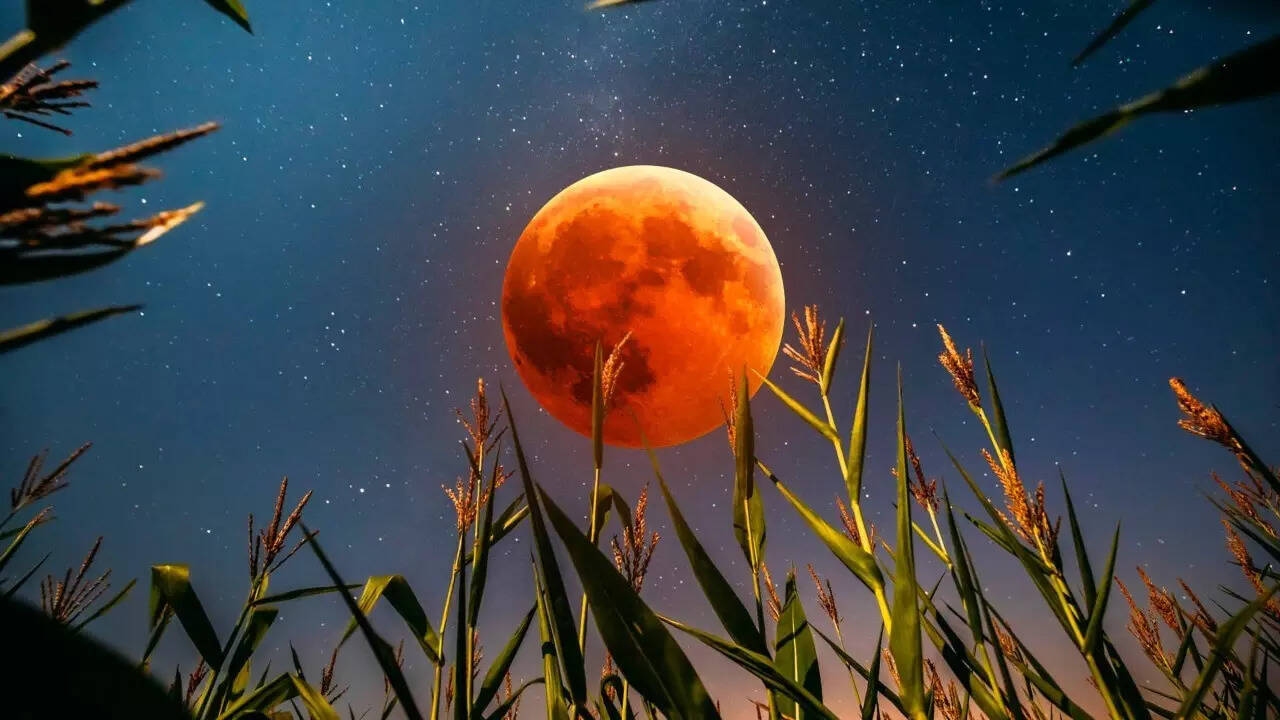

Skywatchers across the world are preparing for a spectacular celestial event as a total lunar eclipse—popularly known as a Blood Moon—is set to illuminate the night sky on the evening of September 7 and into the early hours of September 8, 2025. This rare event is made even more special as it coincides with the full moon known as the Corn Moon.
A total lunar eclipse, also called a Chandra Grahan in many parts of India, occurs when the Earth aligns itself directly between the Sun and the Moon. In this alignment, the Earth casts its shadow onto the Moon, completely obscuring it from direct sunlight. Instead of disappearing entirely, the Moon takes on a striking crimson or reddish hue, a phenomenon that has earned it the dramatic name “Blood Moon.” This reddish color is not a sign of some mystical event, but rather a result of a beautiful atmospheric process: as sunlight passes through Earth’s atmosphere, blue and violet wavelengths are scattered away, while the longer, red and orange wavelengths are bent and refracted onto the Moon’s surface.
This particular total lunar eclipse is notable for its exceptional duration, with the total phase lasting for approximately 82 minutes. This is longer than many recent lunar eclipses, providing an extended window for observers to witness the deep red color of the Moon.
The event’s timing is particularly significant as it occurs during the Corn Moon. In 2025, the September full moon is designated as the Corn Moon, a name with origins in Native American traditions that marked the season for harvesting staple crops. The Corn Moon is also known for rising shortly after sunset for several consecutive days, a feature that historically provided farmers with more light for their late-evening harvests.
The transition from the Corn Moon to the Blood Moon as the eclipse progresses will be a remarkable sight. As the Moon enters the Earth’s shadow, skywatchers will first notice a gradual darkening, followed by the appearance of the copper-red glow that gives the Blood Moon its name.
The total lunar eclipse will be visible in most of Europe, Africa, Asia, and Australia. While those in North America will not be able to see the eclipse directly, many observatories and astronomy websites will be offering live streams of the event. For those in the visible regions, no special equipment is needed to view the eclipse, as it is completely safe to observe with the naked eye.
The next total lunar eclipse visible from India will be on March 3, 2026.