

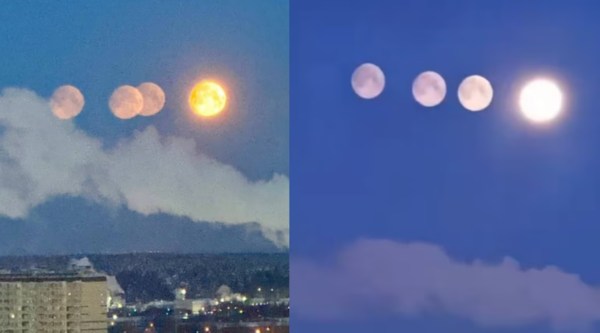

ST. PETERSBURG — Late on Sunday, February 1, 2026, skywatchers in St. Petersburg witnessed what appeared to be four moons glowing simultaneously in the night sky. While the sight sparked social media theories ranging from “alien signals” to “celestial omens,” meteorologists quickly identified the event as a rare and high-intensity display of paraselenae, popularly known as “moon dogs.”
The phenomenon occurred just as the city was gripped by a severe cold wave, with temperatures plummeting below -20°C, providing the perfect “icy canvas” for this atmospheric light show.
1. The Science: Nature’s Prism
A paraselene (the lunar equivalent of a “sundog”) is an atmospheric optical illusion. It is not caused by extra celestial bodies, but by the way moonlight interacts with our own atmosphere.
- Ice Crystals: Tiny, hexagonal ice crystals (often called “diamond dust”) suspended in high-altitude cirrus clouds act as microscopic prisms.
- Refraction: As moonlight passes through these flat crystals, it is bent (refracted) at a precise 22-degree angle.
- The “Four Moon” Effect: While moon dogs typically appear as two bright spots on either side of the Moon, the specific orientation and density of the ice crystals over St. Petersburg on Sunday created additional reflections, resulting in the illusion of four distinct lunar shapes.
2. Why St. Petersburg? The Perfect Storm of Cold
The 2026 Russian winter has been notably harsh, creating ideal conditions for rare optical phenomena.
- Extreme Cold: The -20°C temperature allowed ice crystals to form even at lower atmospheric levels.
- The “Snow Moon” Context: The event happened just hours before the Full Snow Moon (officially full on Feb 2, 2026), meaning the Moon was at its peak brightness, providing enough light for the faint “dogs” to be clearly visible to the naked eye.
- Previous Sightings: Just a week prior, residents on Sakhalin Island reported a similar “two suns” (sundog) event, and “light pillars” were spotted north of St. Petersburg earlier in January, highlighting a particularly active season for Russian atmospheric optics.
3. How to Spot a “Moon Dog”
While rare, you can look for these signs during cold winter nights:
- The 22° Rule: Look for bright patches exactly 22 degrees (roughly the width of two outstretched hands) to the left and right of the Moon.
- Horizontal Alignment: Paraselenae will always sit at the same height above the horizon as the real Moon.
- Faint Colors: If the light is strong enough, you may see a “sideways rainbow” effect, with red tones closest to the Moon and blue tones on the outside.