

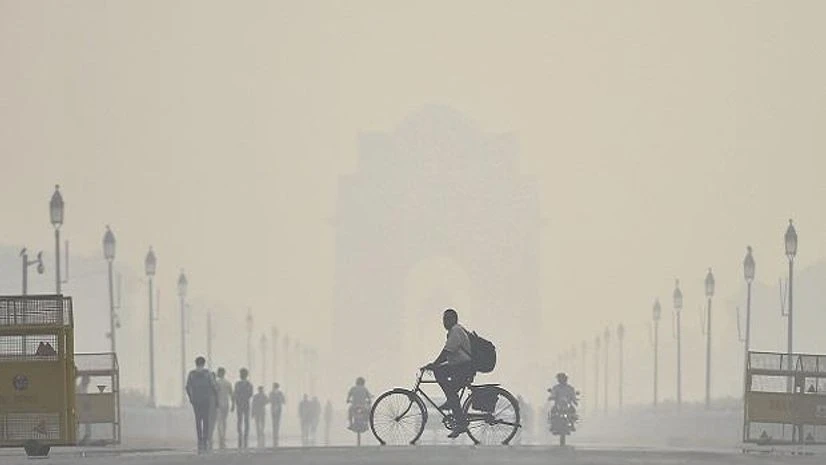

A persistent technical failure has severely hampered the public reporting of Delhi’s air quality, leaving the city’s Air Quality Index (AQI) data frozen and failing to reflect real-time pollution levels as a thick, grey haze continues to shroud the capital on Monday.
The official national air quality platform, the Central Pollution Control Board’s (CPCB) Sameer app, showed the last available update for the city’s average AQI was at 10:43 PM on Sunday, recording a reading of 315—firmly placing the air quality in the ‘very poor’ category. No subsequent updates have been released, marking at least a 12-hour gap in fresh, consolidated data, despite the app typically providing hourly updates.
The same technical issues have rendered the updated AQI data unavailable on the main CPCB website, a problem that began on Sunday when updates were delayed for approximately 11 hours post-noon. Consequently, the CPCB’s daily national bulletin, usually issued at 4 PM, was postponed until 10:45 PM on Sunday, confirming the city’s AQI at 315, a significant deterioration from the 292 (‘poor’ category) recorded on Saturday.
A CPCB official attributed the malfunction to a system overload. “There were some technical glitches. Old data from some stations had flooded our servers and had to be manually fixed,” the official stated, explaining the major delay.
Localized Data Shows High Pollution
Despite the systemic failure to consolidate and publish the city-wide average, monitoring stations within Delhi continued to log extremely high pollution levels before the data freeze. The Sameer app’s last reading at 10:43 PM indicated that out of the 38 active monitoring stations, major pollution hotspots like Anand Vihar (431) and Bawana (401) had already breached the ‘severe’ threshold (AQI over 400), with 23 other stations simultaneously recording readings in the ‘very poor’ category (AQI 301-400).
Meanwhile, the Delhi Pollution Control Committee (DPCC)’s website continued to display hourly readings for all eight pollutants used to calculate the AQI—including $\text{PM}_{10}$, $\text{PM}_{2.5}$, $\text{NO}_{2}$, $\text{SO}_{2}$, $\text{CO}$, $\text{O}_{3}$, $\text{NH}_{3}$, and $\text{Pb}$—confirming that ground-level monitoring equipment remains functional and is collecting the necessary data.
The CPCB defines the Air Quality Index categories as follows:
- Satisfactory: 51 to 100
- Moderate: 101 to 200
- Poor: 201 to 300
- Very Poor: 301 to 400
- Severe: Over 400
This is not the first instance where Delhi’s air quality monitoring has been crippled by server issues. Similar glitches caused data for several stations to be unavailable on occasions like January 1, November 14, 2023, and October 31, 2022, highlighting a recurring vulnerability in the capital’s pollution monitoring infrastructure, particularly during periods of worsening air quality.
The latest forecasts suggest that the city’s AQI is likely to remain in the ‘very poor’ range throughout Monday, with a potential for marginal improvement later in the week due to a possible increase in wind speed.