


Talisman Sabre 2025: A Clear Deterrence Signal to China, Featuring Advanced Capabilities and a ‘Fictitious’ Adversary
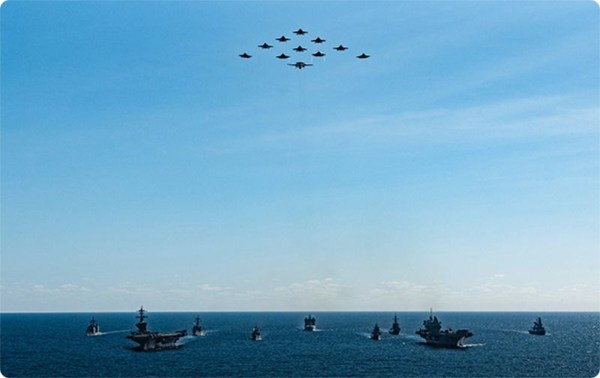
CANBERRA, Australia – Exercise Talisman Sabre 2025, a biennial joint military exercise between Australia, the USA, and 17 other nations, concluded on July 27, 2025, after two weeks of intensive war games across 80 training areas and bases in Australia. Involving over 40,000 military personnel, more than 150 aircraft, and 30 ships, this iteration was the largest and most complex in the exercise’s history, signalling a clear shift in focus towards conventional conflict against a peer adversary.
The ‘Enemy’: The People’s Republic of Olvana
Perhaps the most revealing aspect of Talisman Sabre 2025 was the identity of the notional enemy: the fictitious People’s Republic of Olvana. While seemingly innocuous, the detailed background provided by the US Army’s Decisive Action Training Environment (DATE) leaves little doubt about its true representation. According to DATE, Olvana is a communist nation located in eastern Asia, bordering the Yellow Sea, East China Sea, and South China Sea, with its capital named Shanghai. The description explicitly states: “Today, Olvana’s massive economy and modernising military have enabled it to become a regional hegemon capable of exerting tremendous pressure and influence throughout the region and across the globe.” An accompanying map of Olvana shows it occupying the territory of modern China, making it evident that “Olvana” is a direct stand-in for the People’s Liberation Army (PLA) of China.
This shift from counter-insurgency warfare, which dominated previous Talisman Sabre exercises during the Afghanistan and Iraq conflicts, underscores a clear reorientation towards rehearsing large-scale conventional operations against a technologically advanced force.
Deterrence by Denial: The Core Strategy
Brigadier Damian Hill, Talisman Sabre’s exercise director, while stating that deterrence against Beijing is “not a specific objective of the exercise,” acknowledged its alignment with Australia’s Defence Strategic Review and National Defence Strategy, which advocate for “deterrence via denial.” He emphasized that the exercise contributes to the defense mission of Australia and its national interests, with a primary focus on interoperability among participating nations.
The exercises included a range of activities designed for an Asia-Pacific conflict scenario:
Large-scale Airborne Operations: US Army paratroopers from the 2nd Infantry Brigade Combat Team (Airborne) of the 11th Airborne Division conducted battalion-sized parachute jumps after intercontinental flights from Alaska, demonstrating the ability to rapidly deploy forces 7,000 miles away and seize objectives like airfields.
Airfield Seizures and Amphibious Landings: US Marines, using MV-22B Ospreys, touched down at airfields to expand perimeters for follow-on forces. Along the coast, a multinational fleet conducted amphibious landings, shuttling troops, vehicles, and equipment from ship to shore to establish lodgements.
Island-Hopping Tactics: The US Marine Rotational Force, Darwin (MRF-D), seized remote airstrips in Australia, mimicking the island-hopping campaigns of World War II, a crucial strategy for potential conflicts in the Pacific.
Typhon Missile System’s Inaugural Firing Outside the US
A significant “first” in Talisman Sabre 2025 was the maiden firing of the American land-based Typhon missile system, also known as Mid-Range Capability (MRC), outside the USA. The Hawaii-based 3rd Multi-Domain Task Force (MDTF) of the US Army conducted this event, firing an SM-6 missile hundreds of miles to hit a maritime target north of Australia.
This demonstration is highly significant in the context of deterring China’s anti-access/area-denial (A2/AD) strategy. Within the exercise scenario, the missile was fired to clear waters of enemy naval vessels, mirroring how the US and allies would operate by occupying and defending important links in the First Island Chain (e.g., islands in southern Japan, Taiwan, or the Philippines). By deploying mobile anti-ship missiles like the Typhon or the shorter-range NMESIS, protective bubbles can be created to target PLA Navy warships attempting to penetrate the First Island Chain.
The Typhon can fire both SM-6 and Tomahawk missiles, with the latter capable of dominating waters within a 1,000-mile radius. A dispersed string of such batteries along the First Island Chain would significantly complicate the PLA’s ability to break into the Western Pacific. This demonstration, coupled with the previous deployment of an MRC battery to the Philippines in April 2024 (which remains there), sends a strong signal regarding the deployability and flexibility of these weapon systems.
Other Key Developments and Deterrent Messages
HIMARS Live-Fire: Australia also conducted a live-fire exercise with its newly delivered HIMARS rocket launchers on July 14, another “first” for the exercise.
Geographic Scope: Brigadier Hill emphasized that Australia’s vast geography provided realistic training, allowing nations to test their ability to operate over large distances with limited infrastructure.
Airborne Projection: Colonel Brian Weightman, commander of the 2nd Infantry Brigade Combat Team (Airborne) of the US Army’s 11th Airborne Division, highlighted the deterrent effect of being able to “directly deliver an infantry battalion with its command that is situationally aware and physically optimized onto a drop zone 7,000 miles away,” stating, “I think it should scare adversaries.”
While US military officials maintain they are “not training against a specific adversary,” the capabilities demonstrated and the nature of the “enemy” in the exercise scenario strongly suggest a focus on preparing for potential contingencies involving China. The exercise, with its numerous “firsts” and emphasis on interoperability and advanced strike capabilities, serves as a powerful message of deterrence to any potential “bad actors” in the Indo-Pacific.