

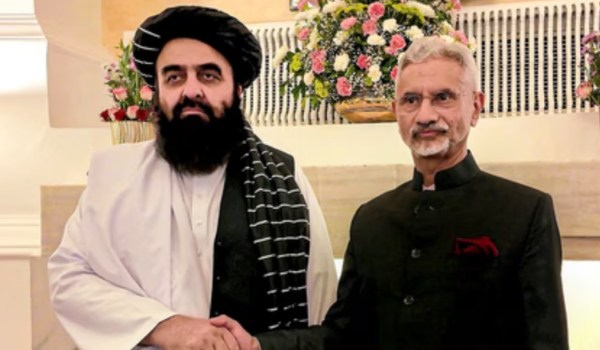

NEW DELHI, INDIA — Amir Khan Muttaqi, the acting Foreign Minister of the Taliban-led government in Afghanistan, is on a high-profile diplomatic trip. However, a big political and gender rights scandal in India has taken over the news. Opposition leaders were quite angry when they heard that women journalists were not allowed to go to a news conference at the Afghan Embassy in New Delhi on Thursday where Muttaqi spoke.
Prominent politicians quickly and strongly condemned the episode, asking how the Indian government could let such unfair tactics happen inside its borders.
Opposition Denounces Exclusion and Calls for Journalists to Stand Together
The purported exclusion of female media workers has caused a lot of anger, especially directed at the Ministry of External Affairs (MEA) and the way the Taliban minister is treated.
P. Chidambaram, a former Union Minister and top Congress politician, said he was really shocked that he wasn’t included. He went to social media platform X to say how upset he was and call for a strong show of support from the media.
Chidambaram remarked, “I am shocked that women journalists were not allowed to attend the press conference that Mr. Amir Khan Muttaqi of Afghanistan held.” “I think the male journalists should have left when they found out that their female coworkers weren’t invited or weren’t included,”
Mahua Moitra, the head of the TMC, took an even tougher stance and explicitly questioned the position of S. Jaishankar, the External Affairs Minister. She was shocked and asked, “How dare our government let Taliban foreign minister Amir Muttaqi hold a ‘male-only’ news conference on Indian soil with full protocol and leave out women journalists?” How could EAM Jaishankar agree to this? And why did our weak, spineless male journalists stay in the room?
Karti P. Chidambaram, a member of Congress, agreed with the criticism and specifically blamed the Modi government for allowing gender-based exclusion in the guise of diplomacy. “I get why we have to deal with the Taliban because of politics, but it’s just plain stupid to go along with their discriminatory and primitive ways,” he remarked. He said it was “very disappointing” that the Ministry of External Affairs and S. Jaishankar kept women media out of the Taliban Minister’s press briefing.
The argument that broke out at the Afghan Embassy in the national capital shows how hard it is for India to deal with the current leadership of Afghanistan while still opposing the Taliban’s policies that limit women’s rights and public participation around the world. So yet, the Indian government has not made any public statement about why the women journalists were not allowed to work.
The Taliban’s First High-Level Visit Amir Khan Muttaqi is in India for a week-long visit from October 9 to October 16. This is the first time since the Taliban took over Afghanistan in August 2021 that a high-level group from Kabul has come to New Delhi.
The visit is a big milestone in India’s careful but growing diplomatic ties with the dictatorship. Minister Muttaqi met with EAM S. Jaishankar on the first day of his visit to talk about ways the two countries may work together to improve their relationship.
India also reiterated its commitment to the Afghan people during the engagement by announcing many new projects for Afghanistan, especially as part of its ongoing healthcare cooperation efforts.