

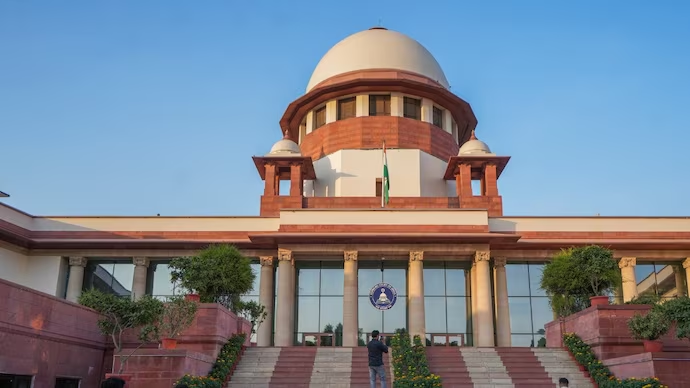

New Delhi: The Supreme Court of India announced on Wednesday that it will begin a continuous hearing on the crucial issue of the statutory age of consent for adolescents on November 12. A bench comprising Justices Vikram Nath, Sandeep Mehta, and N.V. Anjaria stated that it prefers to hear the matter “in continuity” rather than in a “piecemeal” manner, underscoring the importance and complexity of the issue.
The legal debate centers on whether the current statutory age of consent, set at 18 years under the Protection of Children from Sexual Offences (POCSO) Act, 2012, and Section 375 of the Indian Penal Code (IPC), should be lowered. The matter was brought before the court as part of the ongoing assessment of the criminal justice system’s response to sexual offenses.
The Central Government, represented by Additional Solicitor General Aishwarya Bhati, has firmly defended the existing age of 18, describing it as a “deliberate, well-considered, and coherent” policy choice. The government’s written submissions argue that this age is essential for shielding minors from sexual exploitation and that diluting it or introducing exceptions for “adolescent romance” would be “legally unsound and dangerous.” The Centre maintains that any change would “amount to rolling back decades of progress in child protection law” and could “open the floodgates to trafficking and other forms of child abuse under the garb of consent.” It further argued that judicial discretion on a case-by-case basis should not be read into the statute as a general exception.
On the other side of the argument is senior advocate Indira Jaising, who is assisting the court as an amicus curiae. She has urged the Supreme Court to “read down” the statutory age of consent from 18 to 16 years. Jaising’s written submissions challenge the “blanket criminalization” of consensual sexual activity involving adolescents between the ages of 16 and 18. During the hearing, she raised a specific scenario where a consensual relationship between two people in this age group leads to prosecution, highlighting the potential for unintended consequences under the current law.
The bench acknowledged the complexity of the matter, including the intervention applications filed by various parties, but asserted its discretion on whether to entertain them. The judges also noted that this case would be heard alongside a separate suo motu case on the criminal justice system’s response to sexual offenses, with the court stating, “We will deal with it as a whole. We will not segregate the issues. Let it open up, then we will see.”
The continuous hearing from November 12 is expected to delve deep into the legal, social, and policy implications of the age of consent, balancing the protection of children with the realities of adolescent relationships.