


New Delhi:
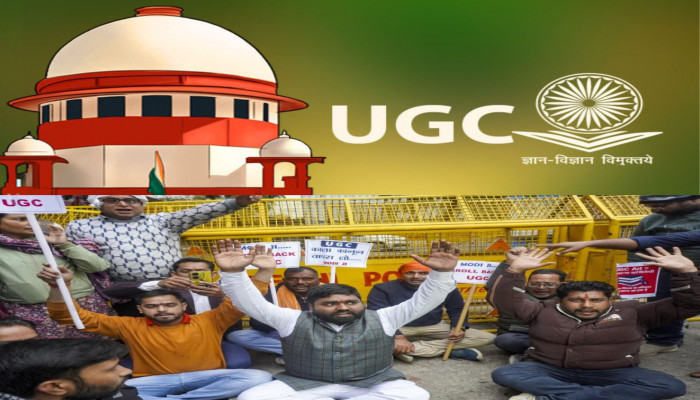
The Supreme Court on Thursday stayed the University Grants Commission (Promotion of Equity in Higher Education Institutions) Regulations, 2026, observing that the framework is “prima facie vague”, capable of very sweeping consequences, and could potentially divide society with a dangerous impact.
A bench comprising Chief Justice Surya Kant and Justice Joymalya Baghchi said the petitions challenging the regulations raise substantial questions of law, warranting detailed judicial scrutiny. The court framed four specific legal questions that will be examined in depth by a three-judge bench.
Court Flags Ambiguities, Possibility Of Misuse
While granting an interim stay, the apex court noted that the new equity regulations suffer from “certain ambiguities”, and warned that “the possibility of their misuse cannot be ruled out.”
The judges expressed concern that the framework, intended to prevent caste-based discrimination on campuses, may lack clarity and adequate safeguards, potentially leading to unintended consequences.
Four Key Legal Questions Framed By Supreme Court
The court said it was of the prima facie view that the following four substantial questions of law arise for consideration:
1. Definition Of Caste-Based Discrimination
Whether the incorporation of Clause 3(c), which defines “caste-based discrimination”, has a reasonable and rational nexus with the objectives of the 2026 UGC regulations—especially when no distinct procedural mechanism has been laid down to address caste-based discrimination separately, unlike the broad definition of “discrimination” under Clause 3(e).
2. Impact On Sub-Classification Within Reserved Categories
Whether introducing and operationalising “caste-based discrimination” affects the constitutional and statutory sub-classification of Most Backward Castes within SCs, STs and OBCs, and whether the regulations provide adequate safeguards to protect Extremely Backward Castes from discrimination and structural disadvantage.
3. ‘Segregation’ And Constitutional Equality
Whether the use of the term “segregation” under Clause 7(d)—in relation to allocation of hostels, classrooms, mentorship groups or academic arrangements, even if done on transparent and non-discriminatory criteria—amounts to a “separate yet equal” classification, violating Articles 14 and 15 and the constitutional value of fraternity under the Preamble.
4. Omission Of Ragging As Discrimination
Whether the absence of “ragging” as a defined form of discrimination—despite its inclusion in the UGC Equity Regulations, 2012—constitutes a regressive legislative omission, and if such exclusion creates unequal access to justice, thereby violating Articles 14 and 21 of the Constitution.
Hearing Scheduled For March 19
The matter will now be heard by a three-judge bench of the Supreme Court on March 19.
About The 2026 UGC Equity Regulations
The UGC (Promotion of Equity in Higher Education Institutions) Regulations, 2026, were notified on January 13. They mandate all higher education institutions to set up Equity Committees to address complaints of discrimination and promote inclusivity on campuses.
These committees were required to include representatives from SC, ST and OBC communities, persons with disabilities, and women.
The 2026 regulations replaced the UGC Equity Regulations, 2012, which were largely advisory in nature.
Why The Regulations Were Challenged
The petitioners have challenged the rules on the ground that caste-based discrimination has been narrowly defined as discrimination only against members of SC, ST and OBC communities, raising concerns over exclusion, ambiguity and unequal protection under the law.