

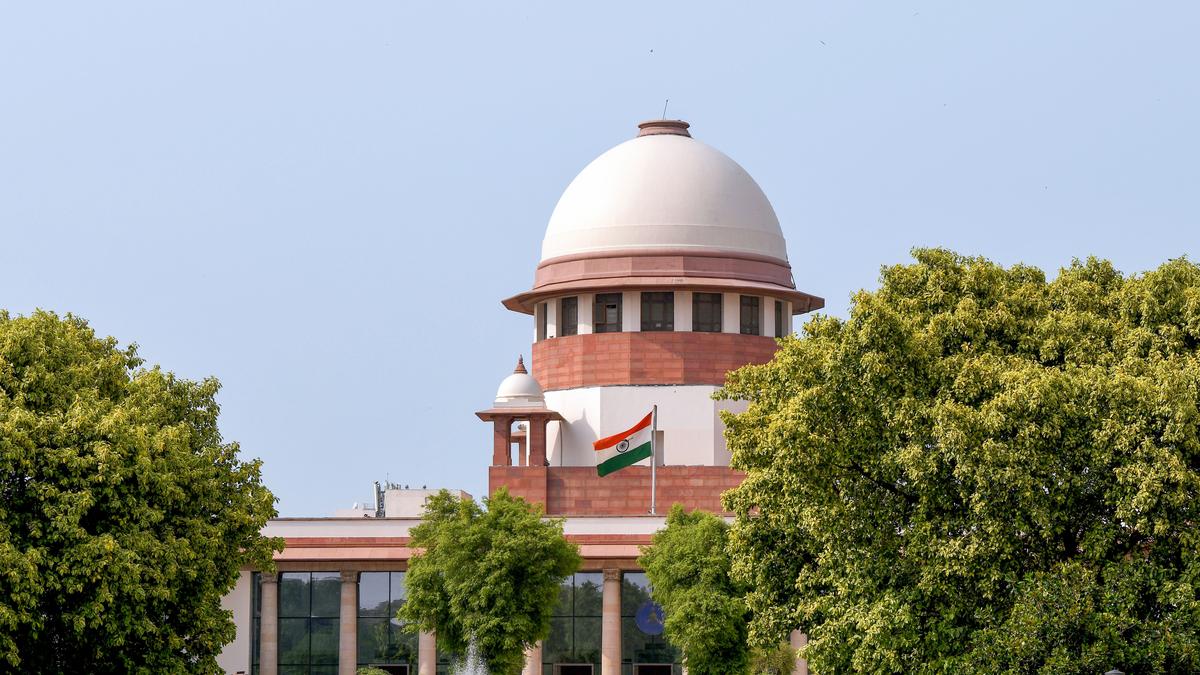

New Delhi: On Tuesday, the Supreme Court started hearing a number of cases that were against the Election Commission’s (EC) Special Intensive Revision (SIR) of the electoral registers in Bihar, which is about to hold elections. Justice Surya Kant said during the hearing that an Aadhaar card cannot be used as proof of citizenship and that the main issue that needs to be answered is whether the EC has the authority to do such a change.
The Justices Surya Kant and Joymalya Bagchi said that the EC is in charge of adding and removing citizens from voting rolls. Justice Kant made it clear what the court thought of Aadhaar by asking, “Are the petitioners saying that an Aadhaar card proves citizenship?” They aren’t saying that it isn’t a measure… The Aadhaar Act says so. The Election Commission is right that Aadhaar can’t be used as definitive proof of citizenship; it needs to be checked. “Check out section 9 of the Aadhaar Act.”
The court turned down the argument that people in Bihar didn’t have most of the documentation the ECI needed for the SIR. Justice Kant said, “This is a case of trust deficiency, that’s all.” The judges made it clear that the main issue was whether the EC had the legal right to do the verification exercise in the first place. “If they don’t have the power, it’s all over.” Justice Kant stated, “There can’t be a problem if they have the power.”
Senior lawyer Kapil Sibal, who is representing Rashtriya Janata Dal MP Manoj Jha, said that the EC’s process will leave a lot of voters out, especially those who couldn’t fill out the necessary documents. He said that even voters who were on the 2003 electoral rolls were being asked to fill out new forms, and if they didn’t, their names were being removed even though their addresses hadn’t changed.
The bench, on the other hand, questioned this argument, saying, “If 7.24 crore voters responded out of 7.9 crore voters, it proves that one crore voters are missing.” The court said the case was “mostly a case of trust deficit” and told the EC to give them comprehensive “facts and figures,” such as the number of votes before and after the exercise and information about voters who had died.
Sibal also brought up worries regarding inconsistencies, giving examples of persons who were thought to be dead but were actually alive and vice versa. Senior counsel Rakesh Dwivedi, who is representing the EC, said that certain “defects here and there” are unavoidable, but he highlighted that the current electoral record is simply a draft and that mistakes may be fixed. He also told the court that almost 6.5 crore people didn’t need to send in new documents because they or their parents were already on the 2003 rolls.
Advocate Vrinda Grover called the change a “unlawful exercise that is within the bounds of parliament.” Yogendra Yadav, an activist, went even farther and said that the operation was “the largest exercise of disenfranchisement in the history of the world,” adding that “65 lakh names have been deleted.” He said that too many women’s names were deleted and questioned the improvements to the process and the idea that the rolls were too big. He warned that “vast exclusion has already begun.”
The draft roll came out on August 1, and the final list will come out on September 30. Manoj Jha, Mahua Moitra, KC Venugopal, and Supriya Sule are some of the opposition leaders who have taken the EC’s order to court.