

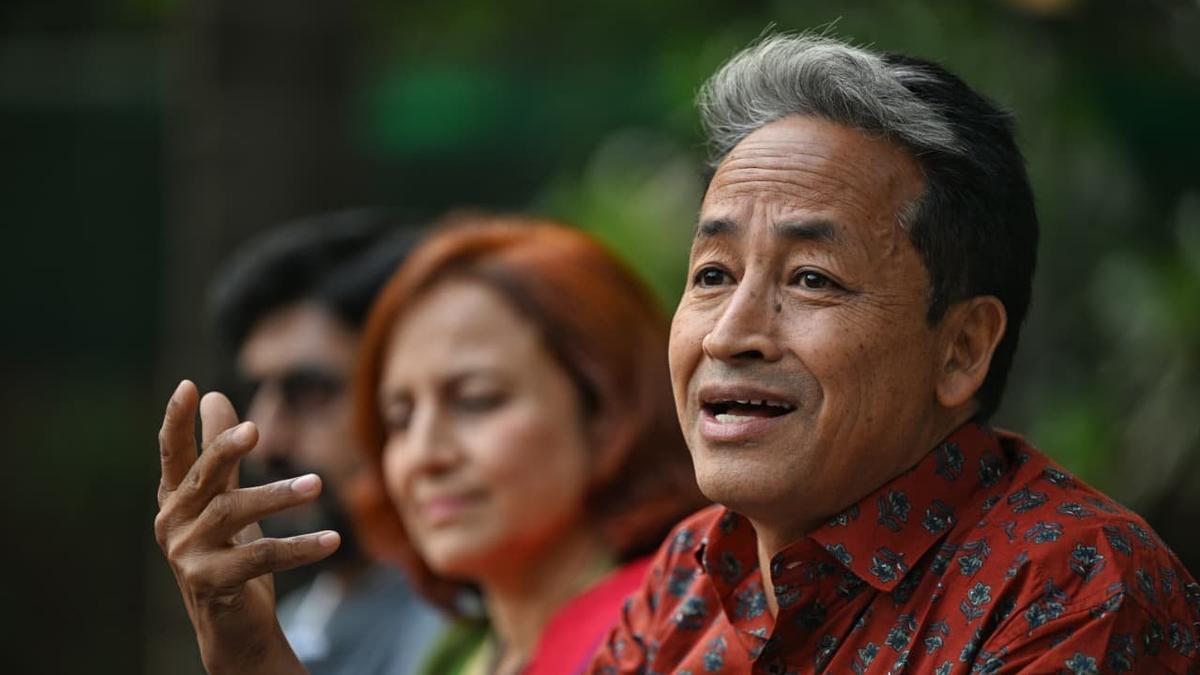

NEW DELHI—Renowned climate activist and educator Sonam Wangchuk addressed the media on Tuesday, March 17, 2026, for the first time since his release from Jodhpur Central Jail. Wangchuk, who had been detained under the stringent National Security Act (NSA) for nearly six months, welcomed the Union Government’s recent outreach as a “positive step” toward resolving the long-standing crisis in Ladakh.
Describing the revocation of his detention as a “win-win” development, Wangchuk emphasized that the movement in Ladakh—spearheaded by the Leh Apex Body (LAB) and Kargil Democratic Alliance (KDA)—remains committed to a “meaningful and constructive dialogue” rather than confrontation.
1. The “Win-Win-Win” Strategy
Wangchuk articulated a vision where a resolution benefits all parties involved:
- The First Win: Rebuilding trust through the government’s decision to revoke the NSA charges and initiate talks.
- The Second Win: Securing constitutional safeguards for Ladakh under the Sixth Schedule and achieving statehood.
- The Third Win: Enhancing India’s global democratic image by demonstrating that internal dissent can be resolved through peaceful negotiation.
2. 170 Days of Detention
The 59-year-old Ramon Magsaysay awardee was detained on September 26, 2025, following a “Climate March” to Delhi that coincided with violent protests in Leh, which tragically resulted in four deaths.
- Isolation: Wangchuk revealed that he was held in total isolation for the first 10 days of his 170-day incarceration, with no access to family or legal counsel.
- Legal Precedent: He expressed hope that the Supreme Court would still deliver a formal judgment on his habeas corpus petition to prevent the future “misuse” of the NSA against peaceful activists.
3. The Road Ahead for Ladakh
While Wangchuk’s release was celebrated in Leh and Kargil with mass rallies on Monday, the core demands of the region remain on the table:
- Consultation: Wangchuk plans to travel back to Ladakh to consult with LAB and KDA leaders before the next round of talks with the Ministry of Home Affairs’ High-Powered Committee.
- Non-Violence: “I am a Gandhian,” Wangchuk stated. “I do not want to sit on a hunger strike; I am forced to do it. Now that the government is extending its hand, we hope a good example is set.”
Ladakh Movement: The Four-Point Agenda
| Demand | Status (as of March 2026) |
| Statehood | Under negotiation; Centre previously cited UT status as essential for security. |
| Sixth Schedule | Key demand for tribal land/resource protection; Centre exploring “safeguards.” |
| Job Reservation | Demand for a dedicated Public Service Commission for Ladakh. |
| Representation | Request for two separate Lok Sabha seats for Leh and Kargil districts. |