

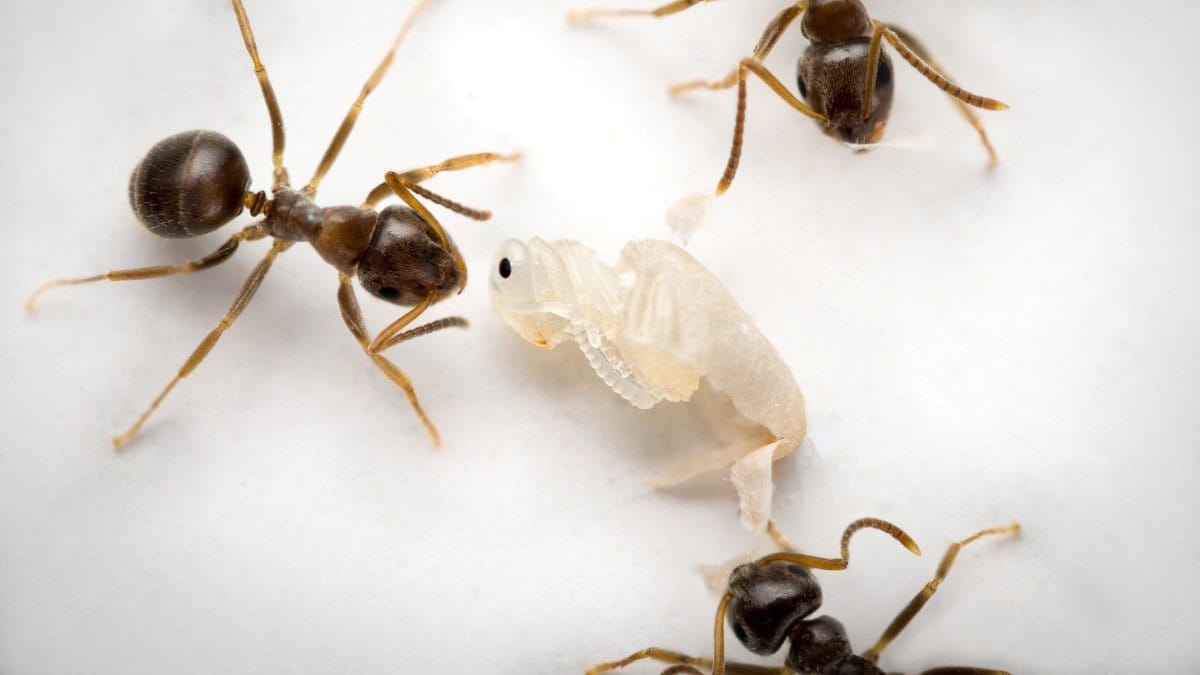

A new study has revealed a remarkable self-sacrifice mechanism in ant colonies: when young ant pupae become fatally ill, they release a chemical scent instructing worker ants to kill them, thereby preventing the spread of disease.
The research, conducted by scientists in Austria, highlights how ant societies function like a highly coordinated “super-organism,” where the survival of the colony is prioritised far above that of any individual member.
Ant colonies are particularly vulnerable to infections because thousands of ants live and interact in tight, enclosed spaces. While adult worker ants can leave the nest to die in isolation when they fall terminally ill, young ants — known as pupae — are sealed inside cocoons and cannot remove themselves from the colony.
Previous observations showed that terminally ill pupae emit a distinct, strong chemical smell due to changes occurring within their bodies as the infection progresses. Worker ants are able to detect this scent, after which they tear open the cocoon and inject poison into the pupae. This poison not only kills the infected young but also disinfects the area, destroying any remaining pathogens.
In the latest series of experiments, scientists extracted this odour and applied it to healthy pupae. Worker ants immediately destroyed these pupae as well, confirming that the smell acts as a direct and deliberate “destroy me” signal. Researchers also found that sick pupae only release this scent when worker ants are present, suggesting purposeful communication rather than an automatic bodily reaction.
Experts describe the behaviour as a powerful example of altruism in the insect world — a self-sacrificial act aimed at preserving the colony’s overall health and ensuring the survival of shared genetic material.
However, the study found that queen pupae behave differently. Unlike worker pupae, queens do not release this chemical warning when infected. Scientists discovered that queen pupae possess stronger immune systems, allowing them to effectively combat infections on their own without signalling for destruction.
Researchers now hope to investigate whether queen pupae ever emit a sacrificial signal when infections become overwhelming and impossible to fight off.
The findings have been published in Nature Communications.