

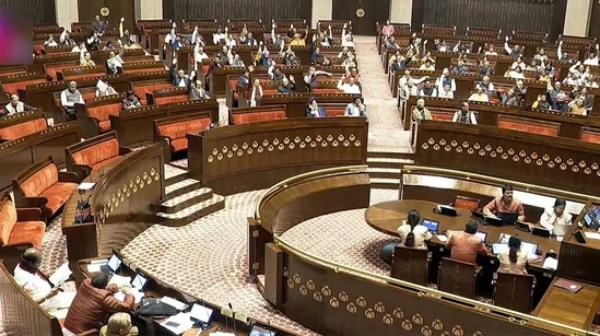

In a historic legislative move, the Indian Parliament passed the Sustainable Harnessing and Advancement of Nuclear Energy for Transforming India (SHANTI) Bill, 2025 on Thursday, December 18. The Bill effectively ends seven decades of state exclusivity, allowing private Indian companies to build, own, and operate nuclear power plants.
Prime Minister Narendra Modi hailed the passage as a “transformational moment,” emphasizing its role in powering AI, semiconductors, and green manufacturing.
Five Key Pillars of the SHANTI Bill
- Private & Foreign Participation: Private Indian companies can now enter the sector as “operators.” While the government retains majority control, private firms can hold up to 49% equity in nuclear projects.
- Repeal of Old Laws: The Bill repeals and replaces the Atomic Energy Act, 1962 and the Civil Liability for Nuclear Damage (CLND) Act, 2010, consolidating them into a single, unified framework.
- Supplier Liability Removed: In a major shift to attract global technology, the “right of recourse” against suppliers (for defective equipment or services) has been removed. Liability is now primarily a contractual matter between the operator and the supplier.
- Graded Operator Liability: The Bill introduces tiered financial liability for operators based on the reactor’s thermal capacity:
- Above 3,600 MW: ₹3,000 crore cap.
- 1,500 MW to 3,600 MW: ₹1,500 crore cap.
- Up to 150 MW (SMRs): ₹100 crore cap.
- Statutory Regulator: The Atomic Energy Regulatory Board (AERB) has been granted statutory status, making it more independent and directly accountable to Parliament.
What Stays with the Government?
Despite the opening of the sector, the Centre will maintain a strict “surveillance and control” monopoly over sensitive strategic areas:
- Nuclear Fuel Enrichment: Uranium enrichment and isotopic separation.
- Spent Fuel Management: Reprocessing and high-level waste management.
- Heavy Water Production: Manufacturing and Upgradation.
- Mining: Exploration and discovery of uranium or thorium.
The “SMR” Strategy: 100 GW by 2047
A core objective of the SHANTI Bill is the rapid deployment of Small Modular Reactors (SMRs). These factory-built, smaller units (up to 300 MWe) are seen as a “plug-and-play” solution for energy-intensive industries like cement, steel, and data centers. The government aims to have at least five indigenous SMRs operational by 2033.
Opposition Concerns: “Not Nuclear, but Unclear”
The Bill faced a walkout by several opposition members who flagged significant risks:
- Safety Accountability: TMC MP Sagarika Ghose called the Bill “fundamentally dangerous,” alleging it gambles with public safety for “crony capitalism.”
- Liability Loopholes: Congress MP Shashi Tharoor termed it an “unclear bill,” questioning a provision that allows the government to exempt certain plants from liability if the risk is deemed “insignificant.”
- State Rights: Opposition leaders argued that local communities and State governments were not sufficiently consulted on the “polluter pays” principle.