

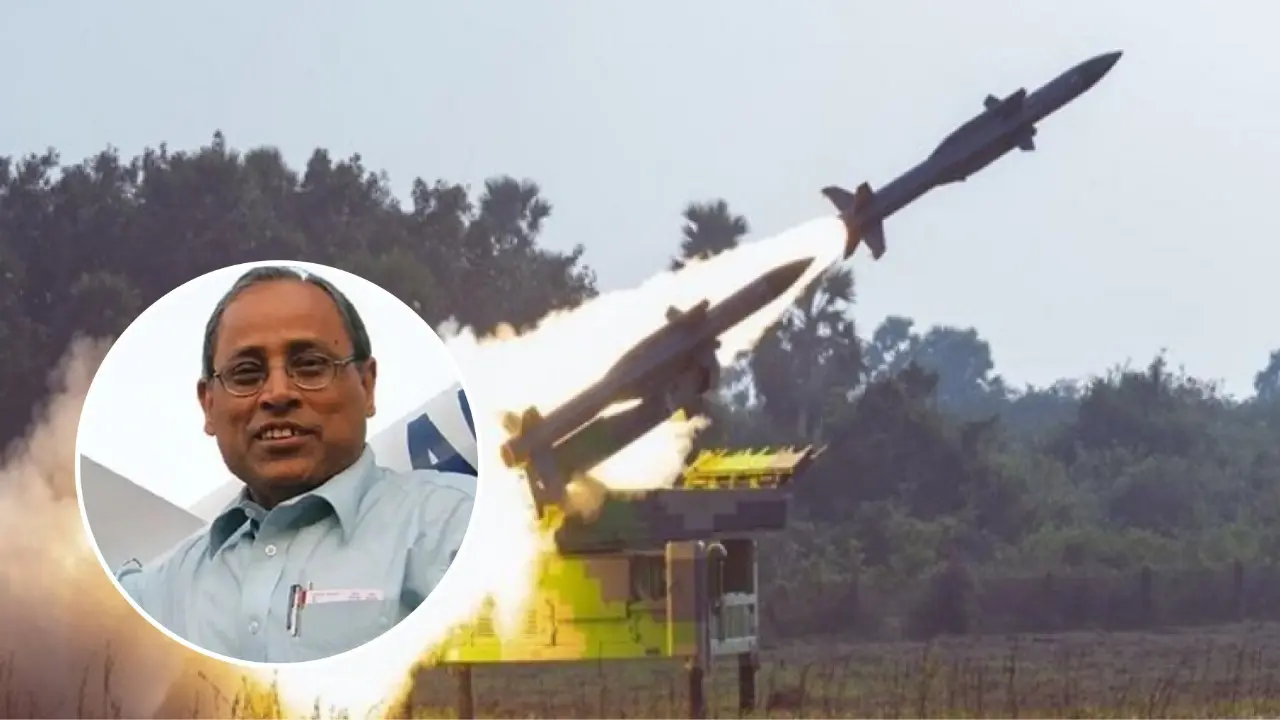

Raipur (Chhattisgarh) [India]: Prahlada Ramarao, the former DRDO scientist behind India’s Akash missile system, recently reflected on the technological milestones and challenges during its development, shedding light on a mission that redefined India’s air defence capabilities.
First conceptualised in 1983, the Akash missile system was born out of India’s urgent need for a homegrown surface-to-air defence solution. At that time, Ramarao was a young scientist at the Defence Research and Development Laboratory (DRDL) in Hyderabad, working under the leadership of Dr. APJ Abdul Kalam.
“In 1983, I was a junior scientist working alongside Dr. Kalam. He was my mentor, and we often discussed testing and modelling. I still remember presenting my findings to him on a chart—he was pleased with my understanding of the problem,” said Ramarao.
By 1984, the project was officially named “Akash,” and to his surprise, Ramarao was appointed Project Director—a daunting responsibility for someone in their early 30s.
“I was scared about handling such a massive responsibility. The project was taking longer than expected, and I wasn’t sure if I could manage it,” he admitted.
Overcoming Complex Challenges
The Akash missile project faced technical and coordination hurdles, especially as it aimed to neutralize fast-moving, manoeuvring aircraft equipped with electronic warfare systems.
“It was complex—missile, radar, ground systems—all needed to operate in perfect synchronization. The Air Force and Army demanded a system that could handle multiple targets simultaneously,” Ramarao noted.
One of the biggest breakthroughs came in the form of a customised radar system with beam agility, allowing rapid target acquisition and tracking.
“The radar had to match enemy aircraft movements and ensure that each missile hit its intended target. This required sophisticated command-control logic and electronic agility.”
Propulsion and Coordination
Another major challenge was missile speed, which led to the development of a Ramjet propulsion system. The effort required coordination among 1,000 scientists across 12 DRDO laboratories in India.
“Coordinating such a massive scientific effort was a monumental task. But the vision and support of Dr. Kalam kept us moving forward,” he said.
Eventually, after over a decade of R&D and rigorous testing, the Akash missile system was integrated into the Indian armed forces—cementing its place as a battle-proven, indigenous defence solution.
Operation Sindoor & Akash’s Role
During Operation Sindoor, India’s calculated military response to the April 2025 Pahalgam terror attack, the Akash missile system demonstrated its critical role. The operation, executed without crossing the Line of Control, saw India strike and destroy terrorist infrastructure across the border using precise, high-tech systems.
Akash, alongside legacy systems like Pechora, OSA-AK, and LLAD guns, showed its efficacy in layered air defence, successfully engaging multiple aerial targets in both autonomous and group modes.
With Electronic Counter-Counter Measures (ECCM) capabilities and full mobility, Akash has become a core asset in India’s strategy to counter modern, asymmetric threats.
Legacy of Innovation
The story of Akash is not just a technological triumph but also a testimony to India’s ability to innovate under constraint. Ramarao’s journey—from a young researcher under Dr. Kalam to leading one of India’s most critical defence projects—stands as a model of visionary leadership and scientific excellence.