

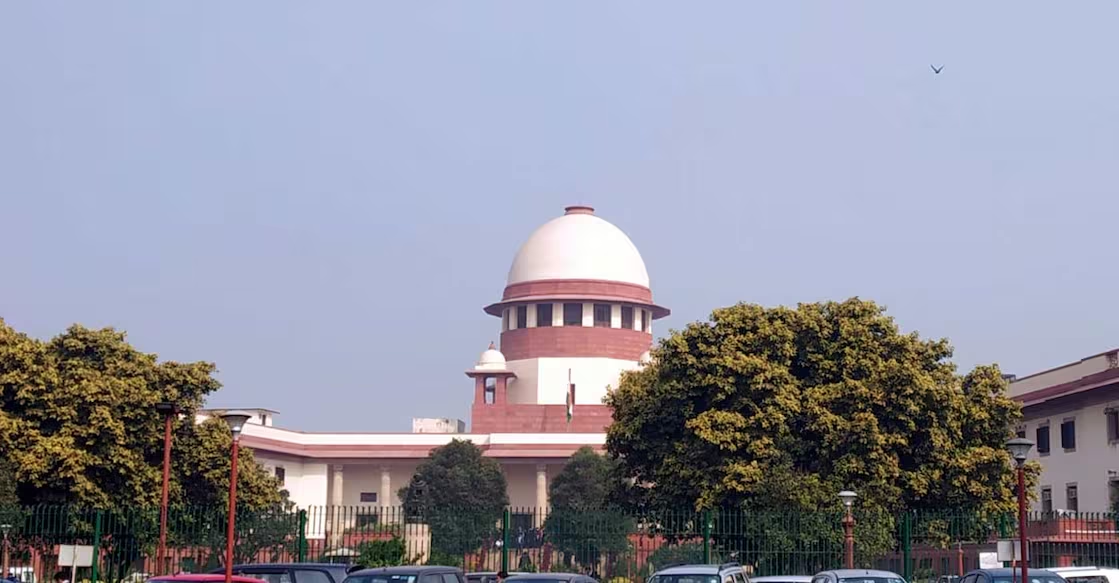

Supreme Court today raised serious concerns about the lack of functional CCTV cameras in police stations across the country, flagging the issue as a failure of “oversight.” A bench of Justices Vikram Nath and Sandeep Mehta, hearing a suo motu case, suggested an innovative solution: a centralized, AI-powered control room to monitor CCTV feeds without human intervention. The Court is set to pass a detailed order on the matter on September 26.
The Court’s intervention comes in the wake of a media report that highlighted 11 deaths in police custody in Rajasthan in the past eight months. Taking suo motu cognisance on September 4, the bench noted that seven of these custodial deaths occurred in the Udaipur division alone. The Supreme Court has a long history of trying to address the issue of custodial torture and human rights abuses, having first ordered the installation of CCTV cameras in police stations in 2018. This was followed by a more comprehensive directive in December 2020, which mandated the installation of cameras at all entry and exit points, main gates, lock-ups, corridors, and even outside lock-up rooms, with night vision and audio-video recording capabilities. The 2020 order also extended the requirement to central investigating agencies like the Central Bureau of Investigation (CBI), Enforcement Directorate (ED), and the National Investigation Agency (NIA).
During Monday’s hearing, Justice Mehta emphasized that simple compliance affidavits from states and agencies are insufficient. “Today there might be a compliance affidavit but tomorrow, there might be instances where police officers might divert or switch off the cameras,” he observed. He proposed a “control room in which there is no human intervention,” where feeds from all cameras are automatically monitored. If any camera goes offline, the system would immediately flag it and report the issue to a concerned oversight agency.
The bench even suggested collaborating with institutions like the IITs to develop the necessary software. “We may think of involving some IIT to provide us with a solution, a software, by which every CCTV feed is monitored at a particular place and even monitoring should not be human, all by AI,” the bench stated.
Senior Advocate Siddhartha Dave, who was appointed as amicus curiae in the matter, brought to the Court’s attention a “glaring fact”: that key central agencies like the NIA, ED, and CBI had not complied with the December 2020 directive. He highlighted that while some states had made efforts to comply with the directive to install cameras in police stations, the central agencies had failed to do so. The court made it clear that it was a suo motu matter and it would not entertain any intervenors unless their assistance was deemed necessary.
The forthcoming order on September 26 is expected to outline a new, technology-driven approach to ensure judicial oversight and accountability in police stations and interrogation centers, with the aim of preventing human rights violations.