

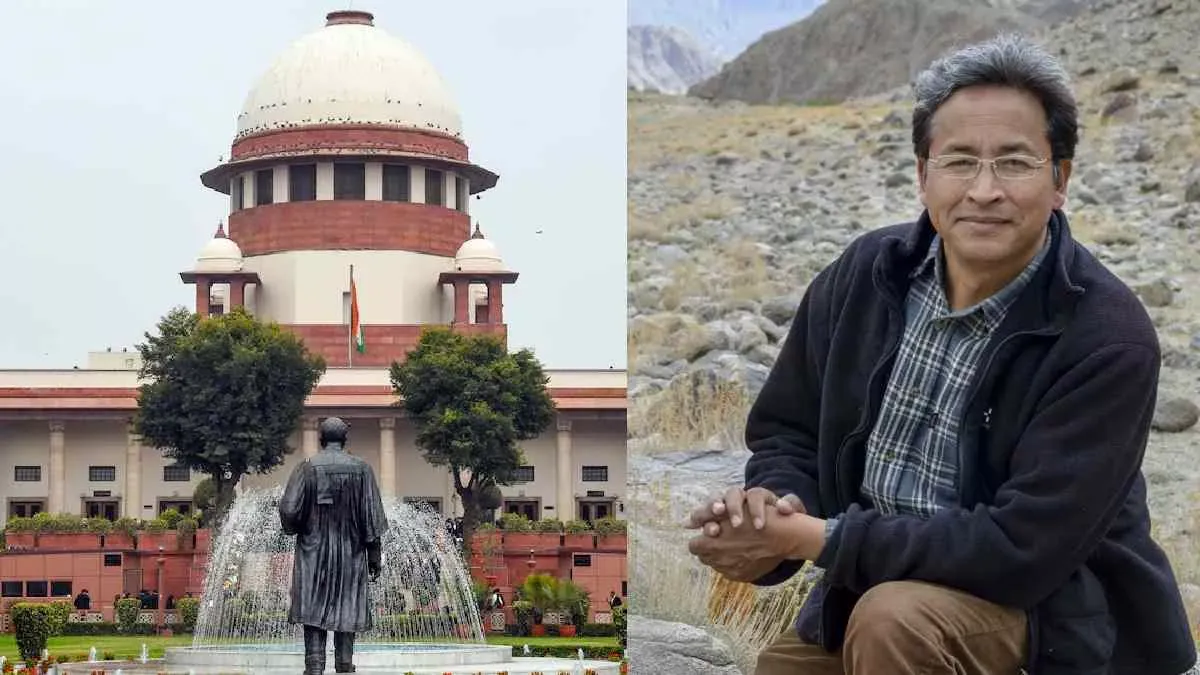

The Supreme Court of India sent a summons to the Union Government and the Ladakh administration about a plea that says Sonam Wangchuk, a well-known Ladakhi education reformer and climate campaigner, should not be held under the strict National Security Act (NSA).
Gitanjali Angmo, Wangchuk’s wife, filed the petition. The Centre and the Union Territory administration, represented by the Solicitor General, told the court that the plea was mostly meant to “create hype” around Wangchuk’s arrest.
A vacation bench of Justices Aravind Kumar and NV Anjaria asked the Centre, the Ladakh administration, and the Superintendent of the Jodhpur Central Jail, where Wangchuk is now being held, to give them more information. The next hearing for the matter is set for October 14.
Arguments About Why Someone Was Detained
Kapil Sibal, a senior lawyer representing Gitanjali Angmo, asked the court for an immediate order telling the authorities to give Wangchuk’s wife the reasons for her husband’s incarceration.
Sibal said that Angmo has not been given the grounds despite asking for them many times, which makes it very hard for her to formally challenge the NSA decision. He said that prior Supreme Court decisions show that family members should also be able to see the reasons for incarceration. He also pointed out that Wangchuk’s wife is not allowed to see him right now.
However, Solicitor General Tushar Mehta, representing the Center, asserted that all legal procedures had been meticulously followed and that Wangchuk’s rights had not been “violated.” Mehta said that the NSA only needs to serve the grounds on the person who is being held, not on their family. He also said that the authorities would “look into the possibility” of giving a copy to the wife, but he asked the court not to “make a big deal out of it.”
The bench decided not to make an interim order for the immediate delivery of the documents since Section 8 of the NSA simply requires that the detained person be told the reasons for their detention. Instead, it said it would first look at the authorities’ official responses.
Questions about medical care and jurisdiction
Sibal went straight to the Supreme Court under Article 32 of the Constitution, saying that the petition was valid because the Centre had issued the detention order. The bench asked why Angmo hadn’t gone to the High Court first, but they finally decided to hear the case next week to decide who has the right to hear it.
The court did not give any more temporary relief, although it did note that the Solicitor General promised that the authorities will make sure Wangchuk’s medical needs are met according to prison rules. The court judgment said, “It is observed that the detainee receives medical care as required, and the same shall be facilitated as per the extant prison rules.”
A little bit about detention
Wangchuk, an engineer, inventor, and winner of the Ramon Magsaysay Award, was arrested on September 26 under the NSA. This happened after protests in Leh two days earlier that turned violent, killing four civilians and injuring many more.
The order to detain Wangchuk says that his comments, which included calls for “self-immolation” as a way to protest, were a threat to public order. Angmo’s petition, on the other hand, says that the incarceration is “illegal” and part of a “systematic and false campaign” to make her husband’s peaceful, Gandhian movement to defend Ladakh’s fragile ecosystem look bad. The petition says that calling environmental activism “anti-national” is a bad idea, especially since Wangchuk’s work has always been about supporting national unity and the Indian Army through new shelter designs.
Wangchuk, who is said to be on a hunger strike, wrote from jail saying he is willing to stay there until an independent judicial probe is ordered into the civilian deaths during the Leh protest. He also advised the people of Ladakh to keep their struggle nonviolent.