

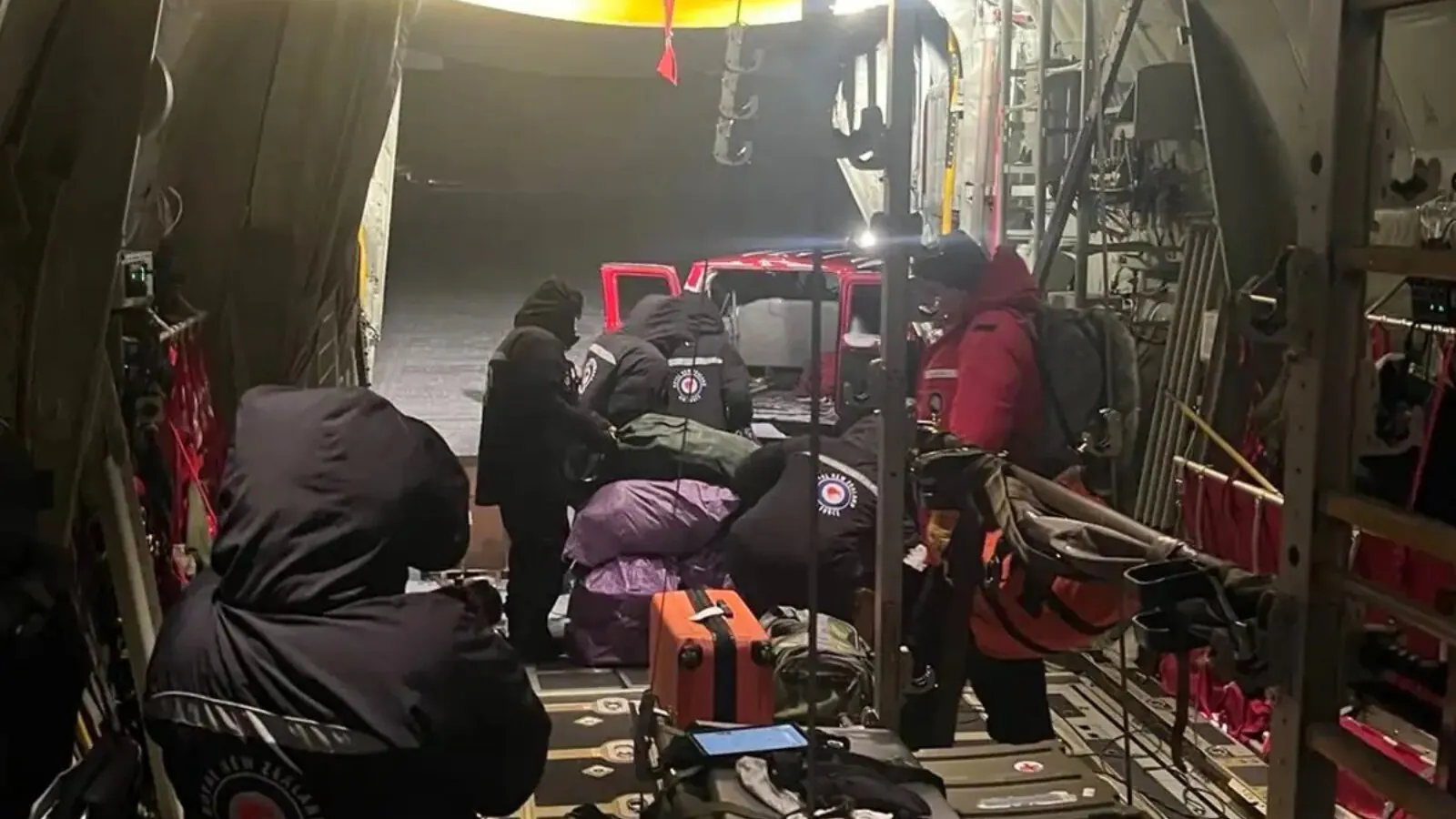

The Royal New Zealand Air Force (RNZAF) successfully carried out a dramatic and complicated medical evacuation this week, flying three researchers from the U.S.-operated McMurdo Station in Antarctica. The expedition started because of a medical emergency. One person needed immediate medical attention, and two more needed more than the station could provide. The operation took place in complete darkness for 24 hours straight, with temperatures dropping as low as -24°C (-11°F).
Air Commodore Andy Scott, the Air Component Commander of the RNZAF, said in a press release that the operation was “one of the most challenging” the crew had ever done. He stressed how much work it took to make the flying feasible.
Scott said, “The crew can only try the flight after they have carefully looked at the weather and the state of the airfield.” “Before we can leave, the United States Antarctic Program Winter Team has to physically make the runway by making sure the ice is smooth and safe for landing.”
Even with these precautions, the flight proved very dangerous. Scott continued, “Even though they say it’s safe, flying in Night Vision Goggles is still very hard because of the extreme weather conditions, which change a lot at this time of year and make it hard to make accurate forecasts.” He also said that the mission was even riskier because there were no other airfields available once the plane crossed a certain point south. He said, “these missions are not taken lightly.”
The McMurdo Station is an important center that supports about 200 winter staff. It needs a lot of help from other countries in case of problems during the Antarctic winter, when people are very isolated and medical supplies are limited.
The RNZAF used a C-130J Hercules plane to carry out the mission, which took 19.5 hours. There was a doctor on board to help during the flight. The three researchers were able to get to Christchurch, New Zealand, where they could get more medical care. Melissa Sweeney, the U.S. Chargé d’Affaires, said she was very grateful for the successful operation and called it “flawless.”
“We are very thankful. Sweeney added, “Our Kiwi partners didn’t hesitate to take on this mission in one of the most difficult places on Earth.” “Their skill and readiness are truly world-class.”