

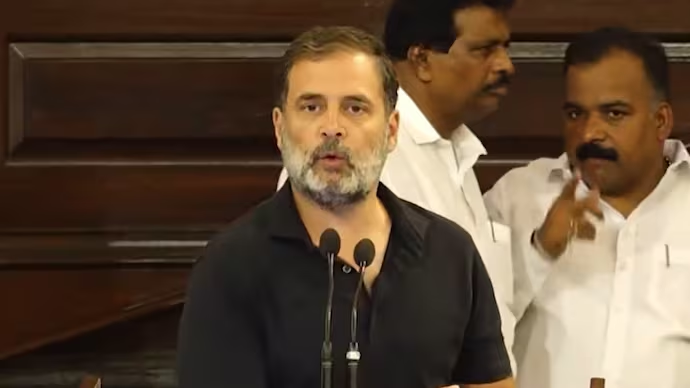

New Delhi, India – The new set of bills proposing the removal of a sitting Prime Minister, Chief Ministers, and other ministers if they are arrested for 30 consecutive days has drawn sharp condemnation from Congress MP and Leader of Opposition in the Lok Sabha, Rahul Gandhi. In a media address, Gandhi stated that the move signals a regression to a “medieval” era where “the king could just remove anybody at will.”
“There’s no concept of what an elected person is,” Gandhi said, criticizing the proposed legislation. “He doesn’t like your face, so he tells ED to put a case, and then a democratically elected person is wiped out within 30 days.”
The three bills—The Constitution (One Hundred and Thirtieth) Amendment Bill, 2025; The Government of Union Territories (Amendment) Bill, 2025; and The Jammu & Kashmir Reorganisation (Amendment) Bill, 2025—were introduced in Parliament by Union Home Minister Amit Shah. They propose that an official would be automatically removed from their position if they are arrested and detained for a period of 30 days or more on charges that carry a minimum jail term of five years.
This provision has sparked widespread outrage among opposition parties, who argue that the bills violate the fundamental principle of “innocent until proven guilty” by allowing for the removal of an elected official based on mere allegations and not a conviction.
The opposition’s strong reaction was visible in the Lok Sabha, where MPs tore up copies of the bills and raised slogans, leading to the adjournment of the House. West Bengal Chief Minister Mamata Banerjee took to social media to call the legislation “more than a super-Emergency” and “a death knell for democracy and federalism in India.” Similarly, AIMIM’s Asaduddin Owaisi argued that the bills infringe upon the separation of powers and give executive agencies “a free run to become judge and executioner.”
Despite the fierce opposition, the government has referred the bills to a joint parliamentary committee for review. The move is seen as a way to allow for further deliberation before the legislation is brought back for a final vote.