

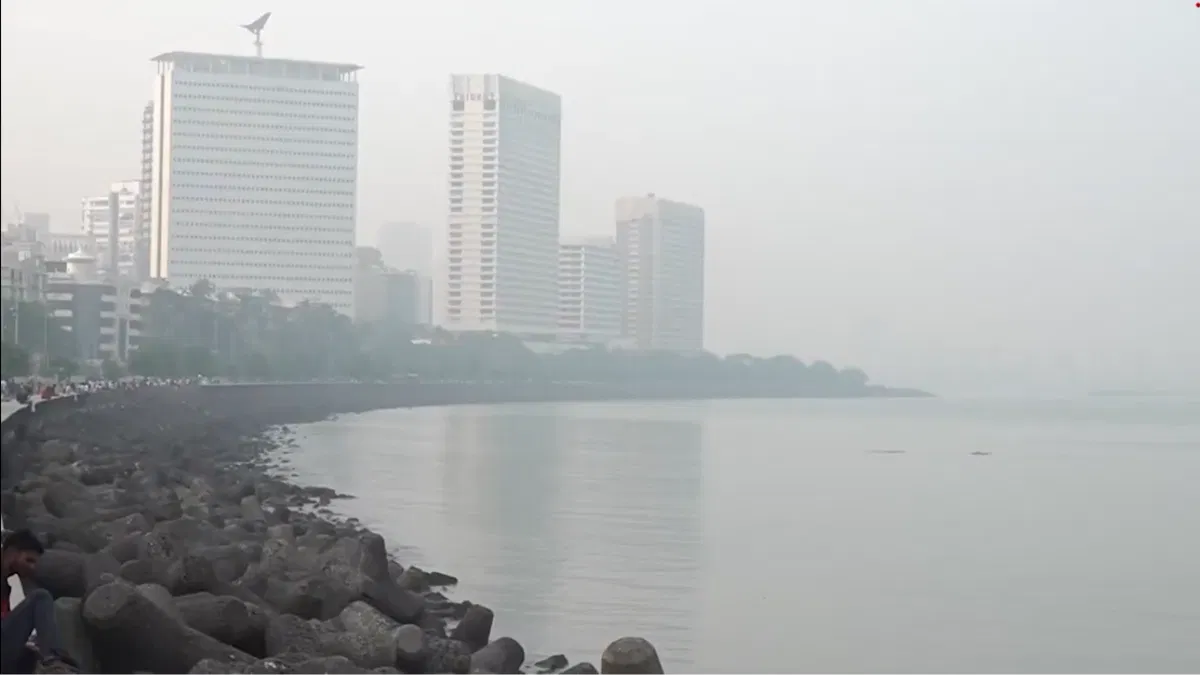

Mumbai, the financial heart of India, woke up to a significant haze on Tuesday, with its air quality index (AQI) plunging into the ‘very poor’ category in the aftermath of Diwali celebrations. The air quality decline mirrored the struggles seen in the national capital, Delhi, underscoring the widespread environmental impact of the festival.
Alarming Morning Spike: AQI Hits 377
At 7:00 am on Tuesday, Mumbai recorded a staggering AQI of 377, firmly placing the city’s air quality in the ‘very poor’ bracket. Early morning visuals from iconic spots like Dadar Beach captured a thin layer of haze obscuring the atmosphere, a direct consequence of post-Diwali pollution.
Data from the Central Pollution Control Board (CPCB) confirmed the severity of the situation, with the Bandra Kurla Complex (BKC)-IITM monitoring station registering the initial reading of 377. This sharp drop is attributed to a combination of slowed wind patterns and the heavy marathon of firecracker bursting that took place on the previous night. Historically, Mumbai, like other major Indian cities, typically experiences a noticeable rise in its overall AQI following the festival of lights.
The major culprit behind the worsening air quality and pollution levels in the city, according to the CPCB, was the PM2.5 pollutant—fine particulate matter that poses significant health risks when inhaled.
City-Wide Air Quality Snapshot
While the early morning reading was alarming, the city’s overall air quality showed a slight improvement by mid-morning. According to the SAMEER app, developed by the CPCB for hourly updates, Mumbai’s overall air quality at 9:06 am was recorded at 212, placing it in the ‘poor’ category.
However, several pockets across the city remained in the hazardous ‘red’ and ‘orange’ zones:
‘Very Poor’ Category (Red Zone: AQI 301-400):
- BKC complex-IITM: 374 (The worst AQI recorded across the city)
- Navy Nagar-Colaba-IITM: 346
- Mazgaon-IITM: 309
‘Poor’ Category (Orange Zone: AQI 201-300):
- Malad West-IITM: 280
- Deonar-IITM: 274
- Siddharth Nagar-Worli-IITM: 269
- Byculla-BMC: 267
- Chakala-Andheri East-IITM: 261
- Borivali East-IITM: 246
- Powai-MPCB: 233
- Chembur-MPCB: 230
- Kandivali West-BMC: 219
- Kherwadi-Bandra East-MPCB: 215
- BKC-MPCB: 211
- Mulund West-MPCB: 206
‘Moderate’ Category (AQI 101-200):
The rest of the city recorded air quality in the ‘moderate’ category, including: Vasai West-MPCB (107), Kurla-MPCB (115), Worli-MPCB (122), Khindipada-Bhandup West-IITM (130), Shivaji Nagar-BMC (141), Kandivali East-MPCB (151), Colaba-MPCB (152), Vile Parel West-MPCB (157), Sewri-BMC (173), Borivali East-MPCB (180), Mindspace-Malad West-MPCB (181), Sion-MPCB (188), and Ghatkopar-BMC (192).
Understanding the AQI Categories
As per the Central Pollution Control Board (CPCB) standards, the Air Quality Index is classified as follows:
- Good: 0 to 50
- Satisfactory: 51 to 100
- Moderate: 101 to 200
- Poor: 201 to 300
- Very Poor: 301 to 400
- Severe: 401 to 450
- Severe Plus: Above 450
Mumbai Weather Forecast
In terms of weather, the India Meteorological Department (IMD) has not issued any specific warnings for Mumbai on Tuesday. The minimum temperature is expected to settle at 25 degrees Celsius, with the maximum temperature likely to hover around 36 degrees Celsius. The weather office predicts a clear sky throughout the day, a factor that should aid in slowly dissipating the smog envelope that was witnessed in the morning hours.