

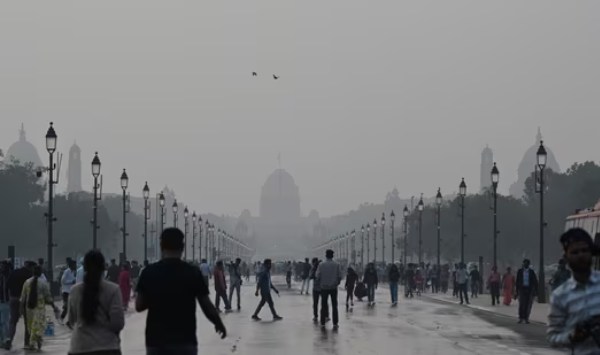

Delhi woke up to another day of toxic smog as the city’s air quality remained firmly in the ‘Very Poor’ category on Monday morning. The overall Air Quality Index (AQI) was recorded at 397 at 6 am by the Central Pollution Control Board (CPCB), propelled by low wind speed and falling temperatures.
The city’s air has consistently stayed in the ‘Very Poor’ zone for nearly 18 continuous days since November 6, with three ‘Severe’ air days occurring between November 11 and 13. Multiple factors, including the onset of winter and farm fires following Diwali, have plunged the capital’s air into distress.
AQI at Monitoring Stations
The high readings indicate a widespread crisis, with over half of the monitoring stations slipping into the worst zone:
- Severe Zone (AQI > 400): Twenty out of 39 monitoring stations recorded AQI above 400.
- Worst Affected Areas: The highest AQI readings were reported in Vivek Vihar and Rohini at 458, followed closely by Jahangirpuri at 455, Wazirpur (448), and DTU (444).
The daily average AQI has shown little improvement, standing at 391 at 4 pm on Sunday, slightly higher than the 370 recorded at the same time on Saturday.
Health Concerns and Government Action
The continuous siege of toxic smog has triggered a surge in health concerns among residents, with increased reporting of respiratory, ocular, and pulmonary issues. Doctors and health experts have sounded alarm bells over the long-term health implications, prompting the government to put measures of the Stage 4 of the Graded Response Action Plan (GRAP) into effect under the less-severe Stage 3 classification to proactively curb pollution sources.
Pollution Protest Turns Chaotic at India Gate
Concerned over the worsening air quality and its severe health implications, several citizens gathered for a protest at India Gate on Sunday evening. However, the demonstration quickly turned tense and chaotic.
- Police Intervention: According to a senior police officer, the protesters had gathered near the C-Hexagon and were told that their demonstration was obstructing ambulances and medical personnel attempting to pass through the area.
- Use of Chilli Spray: When police advised the protesters to step back, the situation escalated into a scuffle. Deputy Commissioner of Police (New Delhi), Devesh Kumar Mahla, told PTI that, in a rare and unusual move, some demonstrators allegedly used chilli spray (pepper spray) on police personnel managing traffic and law and order.
- Legal Action: “A few of our officers were sprayed in the eyes and face and are currently receiving treatment at RML Hospital,” Mahla confirmed, adding that legal action would be taken against those involved in the attack.
The protesting group released a statement saying, “When the state makes the air itself poisonous, it becomes necessary for people to unite and raise their voices for their own survival.”