

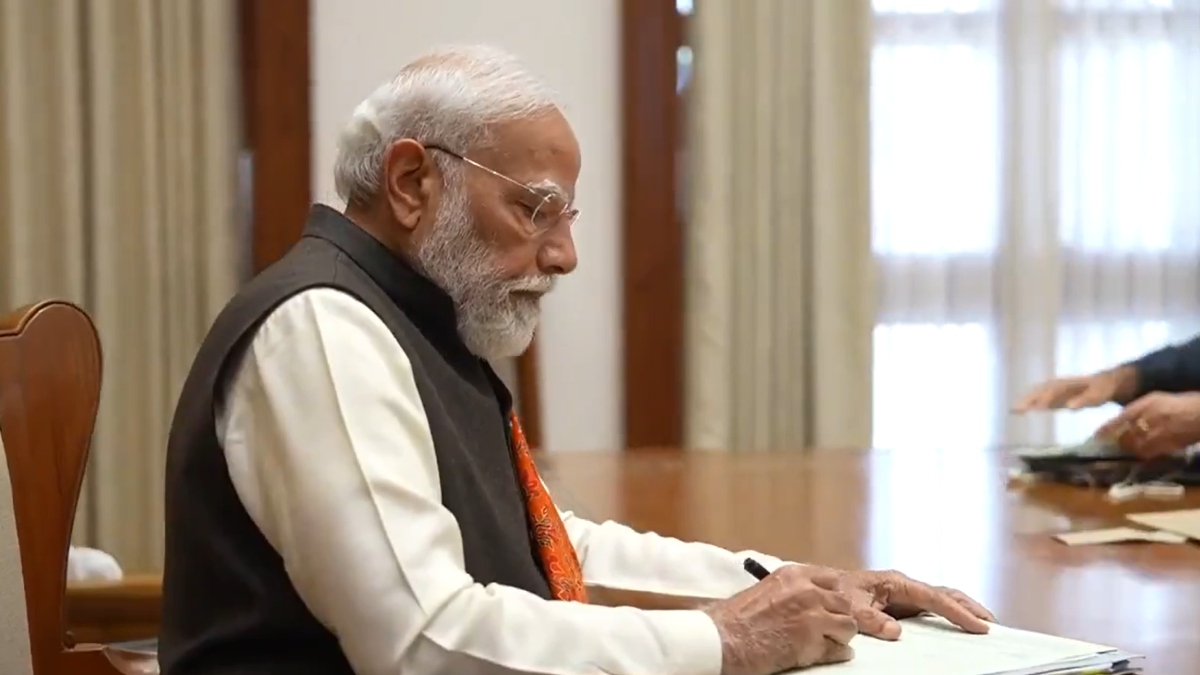

NEW DELHI — In a historic shift of India’s administrative nerve center, Prime Minister Narendra Modi inaugurated the Seva Teerth (the new PMO complex) and two central secretariat buildings, Kartavya Bhawan 1 and 2. The move, occurring on the 95th anniversary of New Delhi’s formal 1931 inauguration, replaces the century-old South and North Blocks with state-of-the-art facilities designed for modern, digital-first governance.
“Raisina Hill was chosen so that these buildings would stand above all others… Seva Teerth is not on a hill but connected to the ground. These buildings will serve as the foundation to advance the expectations of 140 crore citizens.” — PM Narendra Modi
1. The First Decisions: Empowering the Four Pillars
Immediately after taking his seat at Seva Teerth, the Prime Minister signed four critical files targeting women, farmers, youth, and public safety:
| Scheme / Initiative | Key Decision & Figure |
| Lakhpati Didi Scheme | Target doubled to 60 million women (6 crore) by March 2029; focuses on annual household income of ₹1 lakh for SHG members. |
| Agri-Infrastructure Fund | Target doubled to ₹2 lakh crore to stimulate investment in post-harvest management and farming assets. |
| Startup India Fund (2.0) | Approved a corpus of ₹10,000 crore to boost deep-tech and early-stage innovations. |
| PM RAHAT Scheme | New Launch: Provides cashless treatment up to ₹1.5 lakh for accident victims across India. |
2. The New Governance Map: From Colonial to “Kartavya”
The inauguration is part of a broader vision to replace British-era nomenclature and infrastructure with “citizen-centric” symbols.
- Seva Teerth: Houses the PMO, the National Security Council Secretariat (NSCS), and the Cabinet Secretariat under one roof.
- Kartavya Bhawan 1 & 2: These buildings now accommodate 11 major ministries, including Finance, Defence, Health, and Education, ending the fragmentation of offices across 50 different locations.
- Metro Renaming: Union Minister Manohar Lal Khattar announced that the Udyog Bhawan Metro Station on the Yellow Line will now be known as Seva Teerth Bhawan Station.
3. Why the Change? Efficiency and Economy
The Prime Minister highlighted that the old British-era structures were not only symbols of “slave mentality” but were physically deteriorating and financially draining.
- Space Constraints: Nearly 100-year-old buildings like South Block were inadequate for modern tech and expanded staff.
- Cost Savings: Functioning from 50+ locations cost the exchequer ₹1,500 crore annually in rent; the consolidation will significantly reduce these overheads and save employees’ travel time.
- Sustainability: The new complexes are built to 4-Star GRIHA standards, featuring renewable energy, water conservation, and high-performance waste management.
4. Historical Context: A New Museum
The Prime Minister clarified that while the government is moving forward, the history within South and North Blocks will not be erased. These historic structures will be preserved as part of the Yuge Yugeen Bharat Museum, chronicling the decisions that shaped independent India over the last 78 years.