

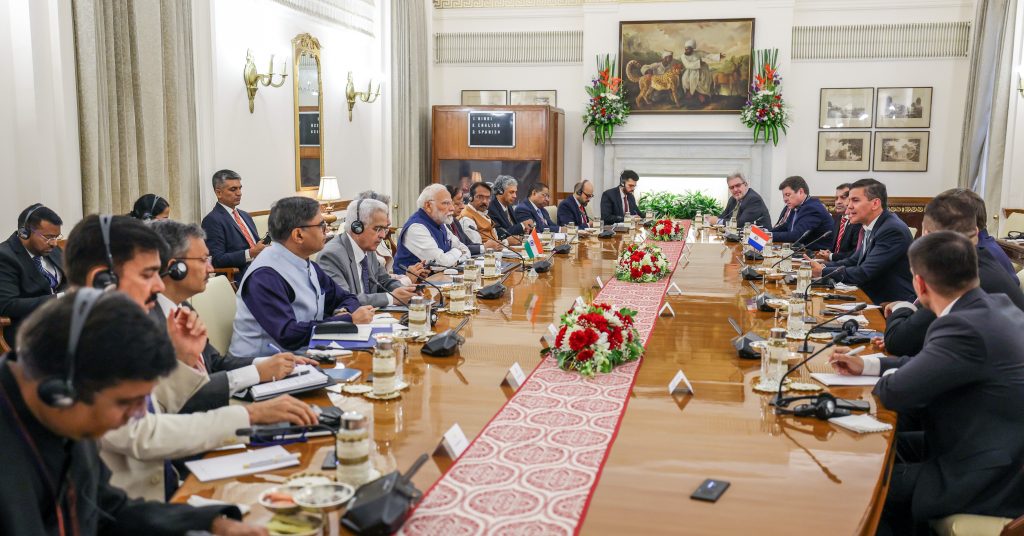

New Delhi — Prime Minister Narendra Modi hosted Paraguayan President Santiago Pena at Hyderabad House on Monday during the latter’s ongoing State Visit to India from June 2–4. The two leaders held wide-ranging talks focused on deepening cooperation across agriculture, pharmaceuticals, technology, renewable energy, health, critical minerals, and railways.
Strong Condemnation of Pahalgam Terror Attack
In a significant show of solidarity, President Pena strongly condemned the April 22 terrorist attack in Pahalgam, Jammu & Kashmir, and extended condolences to the victims and their families. Both leaders also shared perspectives on global and regional issues of mutual interest.
Strategic Sectors in Focus
The meeting marks a boost in India–Paraguay ties, particularly in:
- Digital technology and innovation
- Critical mineral sourcing and green energy
- Agricultural cooperation and food security
- Pharma and healthcare
- Space and science collaboration
- People-to-people exchanges
PM Modi emphasized that Paraguay is a “valued partner in South America,” highlighting shared values and economic synergy between the two democracies.
🗣️ “There is immense potential in boosting trade linkages… digital technology, critical minerals, energy, agriculture, health, and space are key areas for cooperation,” PM Modi wrote on X.
Historic Visit: Only the 2nd by a Paraguayan President
This is President Pena’s first visit to India and only the second-ever visit by a Paraguayan head of state. He is accompanied by a high-level delegation comprising ministers, top officials, and business leaders.
Following his engagements in Delhi, President Pena will travel to Mumbai, where he will meet:
- State political leadership
- Indian industry and startup ecosystem
- Innovators and technology companies
Background on India–Paraguay Relations
India and Paraguay established diplomatic ties in 1961. Since then, cooperation has expanded to include trade, health, agriculture, education, and IT. The current visit aims to elevate this relationship, especially within the Global South’s collaborative framework.