

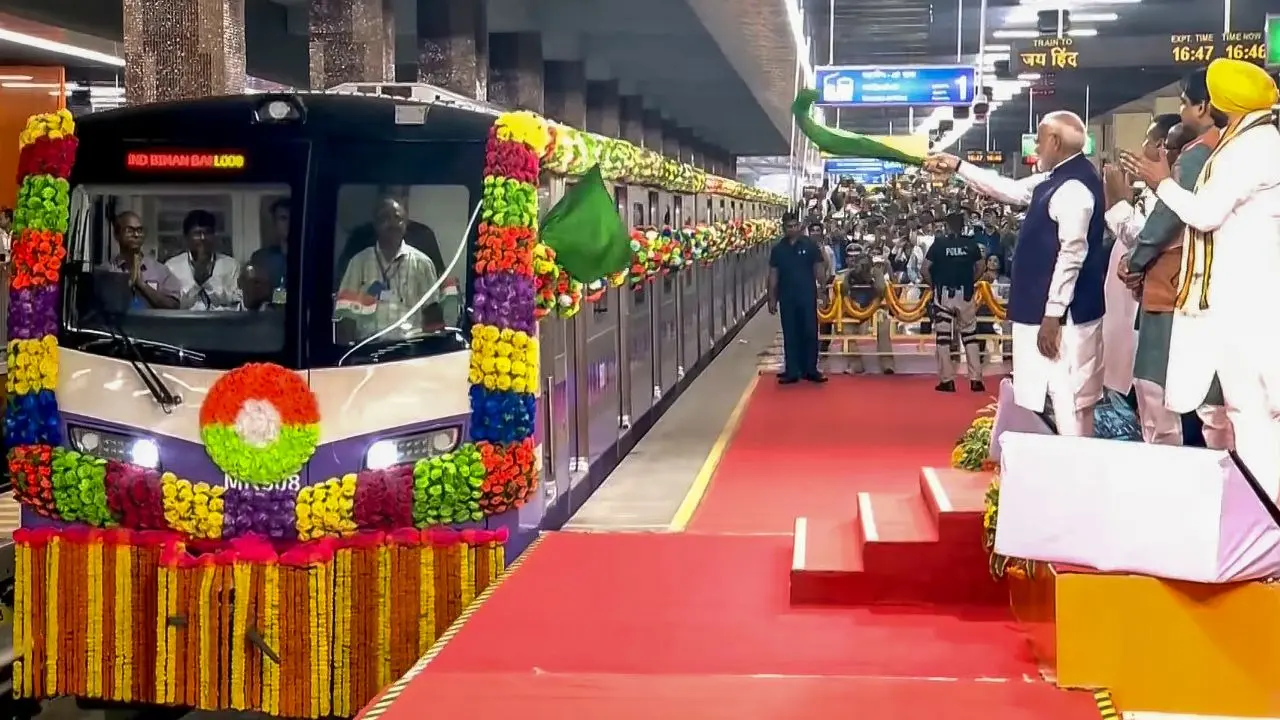

KOLKATA— Prime Minister Narendra Modi went to Kolkata on Friday to open many metro railway projects. This visit showed how important it is to the government to modernize the infrastructure in cities. The Noapara–Jai Hind Bimanbandar metro service and the Sealdah–Esplanade metro service are two of the projects that are part of a bigger plan to improve the city’s transportation and cut down on traffic jams.
PM Modi told a large crowd that the new projects are a sign of “today’s India working for the development of every city” as the country draws closer to being the third-largest economy in the world. He welcomed the growth of the metro system, saying, “Everyone is proud that India has the third largest metro system in the world.” He noted that before 2014, the country only had 250 kilometers of metro routes. Now, that number has grown to more than 1,000 kilometers.
The Prime Minister also rode the metro from Jessore Road Metro Station to Jai Hind Bimanbandar and back, where he talked to people who were riding. He told the people of Kolkata, “Everyone is happy that Kolkata’s public transport has gotten better.”
The new parts that just opened are anticipated to make it more easier for people who commute every day. The Sealdah-Esplanade metro line will cut the travel time between the two main train stations from around 40 minutes to just 11 minutes. The Beleghata-Hemanta Mukhopadhyay metro line would make it easier for people to get to the city’s growing IT industry.
Mamata Banerjee, the Chief Minister of West Bengal, did not come to the opening. She used social media site X to talk about how she helped with the expansion of Kolkata’s metro in the past. She said that as India’s previous Railway Minister, she had “drawn the blueprints, arranged the funds, [and] initiated the works” for a series of metro corridors in Kolkata. This showed how important she was to the city’s metro growth.
The new metro lines in Kolkata add about 14 km to the city’s metro network. They include a link to the airport and an extension of the metro line that runs under the river. The projects are part of a nationwide effort to promote “green mobility,” which means making it easier for people to go around in an environmentally friendly way. This includes adding more electric charging stations and electric buses to the metro system.