

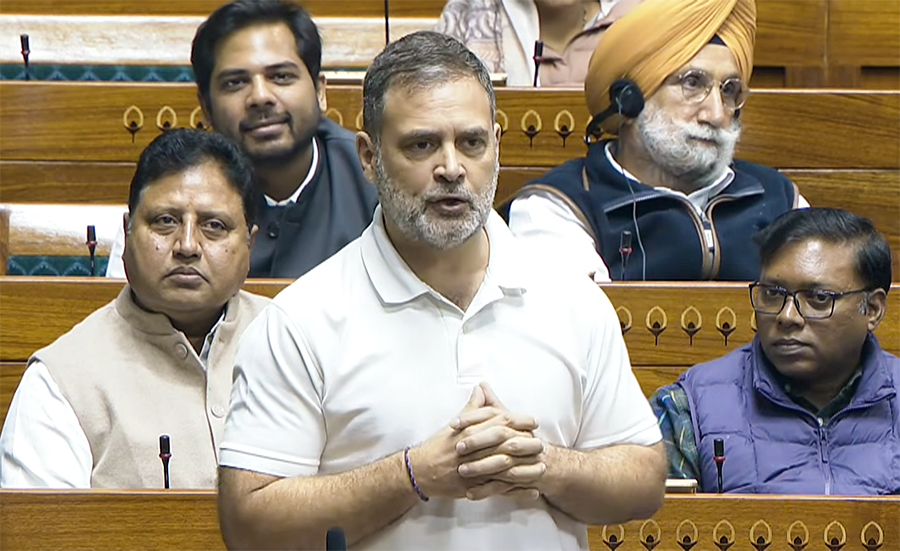

New Delhi: A long-pending discussion on air pollution is expected to take place in Parliament on Thursday during the ongoing Winter Session, with Union Environment Minister Bhupender Yadav set to address the House. The debate follows a strong demand from Leader of the Opposition in the Lok Sabha, Rahul Gandhi, who described India’s air pollution crisis as a “national health emergency.”
Raising the issue on December 12, Gandhi warned that hazardous air quality is affecting millions of people across the country, with children bearing the brunt through rising cases of respiratory and lung-related diseases. He urged lawmakers to rise above political differences and treat air pollution as a public health concern rather than an ideological issue.
“Most of our major cities are living under a blanket of poisonous air,” Gandhi said, calling for a structured, solution-oriented debate focused on long-term corrective measures instead of assigning blame.
Responding to the demand, Parliamentary Affairs Minister Kiren Rijiju assured the House that the government is open to discussion. He said the issue would be taken up in consultation with the Business Advisory Committee to allocate sufficient time for a meaningful debate.
Ahead of the expected parliamentary discussion, Environment Minister Bhupender Yadav on Wednesday chaired the third in a series of high-level review meetings on air pollution mitigation in the Delhi-NCR region. The meeting focused on evaluating action plans prepared by municipal bodies in Delhi and Sonipat.
Yadav emphasised the need for a “practical approach” to tackling pollution, calling for targeted action against major sources of emissions while ensuring that ordinary citizens are not unduly inconvenienced. He stressed the importance of adopting a ‘Whole-of-Government’ and ‘Whole-of-Society’ approach to address the crisis and improve Delhi’s global image.
During the meeting, several key directives were issued to strengthen pollution control efforts. These included a ban on construction and demolition activities that lack proper waste management facilities within a 10-kilometre radius, along with a complete prohibition on demolitions during the peak pollution months of October to December.
Authorities were also instructed to launch immediate inspection drives across the NCR with strict enforcement, while prioritising awareness and compliance over excessive penalties. To ease traffic congestion and reduce vehicular emissions, directions were issued to remove encroachments and illegal parking from 62 identified traffic hotspots in Delhi. Plans are also underway to develop signal-free corridors during peak hours, with restrictions on vehicles below BS-IV emission standards.
The minister further highlighted the need to strengthen last-mile public transport connectivity, particularly for residents of high-rise buildings. Expansion of waste-to-energy projects at legacy dump sites such as Okhla, Bhalswa and Ghazipur was discussed, with a target to fully liquidate these sites by 2026.
Public participation was identified as a crucial component of pollution control. Proposed measures include awareness campaigns, corporate social responsibility (CSR)-funded heating arrangements for workers to curb biomass burning, and initiatives to green open and degraded spaces across the city.
The review meeting was attended by senior officials from the Ministry of Environment, the Commission for Air Quality Management (CAQM), the Central Pollution Control Board (CPCB), the Delhi Pollution Control Committee (DPCC), and municipal commissioners from the region.
As air quality continues to deteriorate across northern India, Thursday’s parliamentary debate is expected to play a key role in shaping future policy responses to one of the country’s most pressing environmental and public health challenges.