

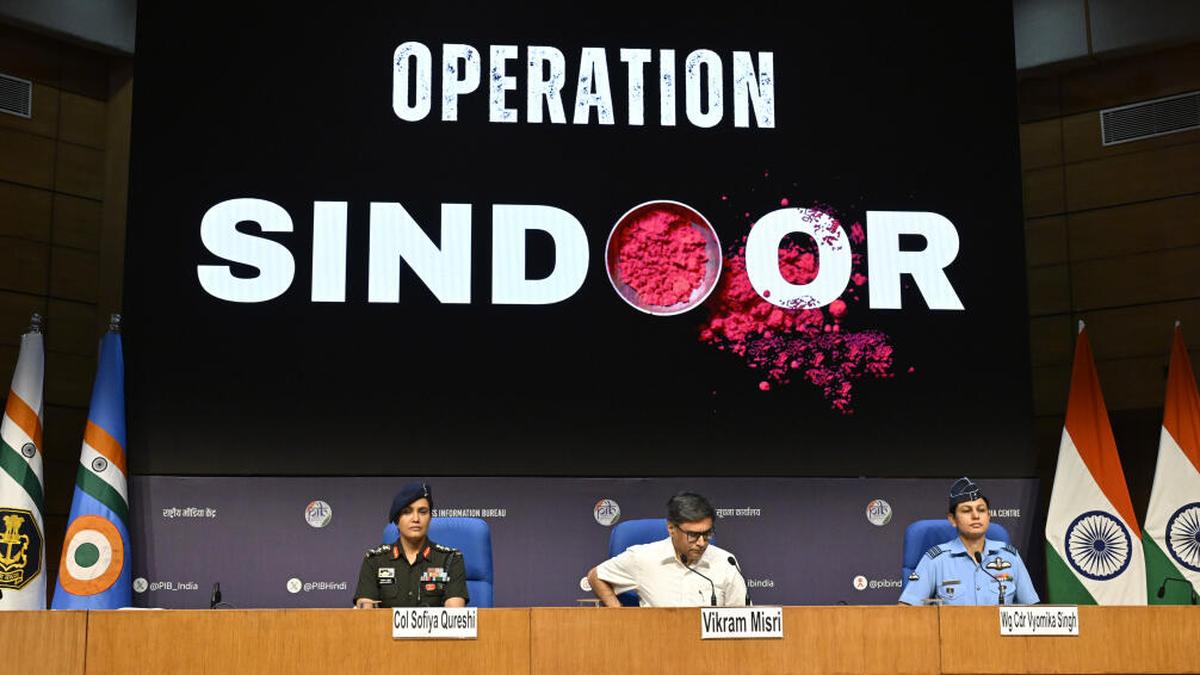

New Delhi [India], May 12: Detailing the strategic impact of Operation Sindoor, the Indian Armed Forces on Monday outlined the successful targeting of nine terror infrastructure sites in Pakistan and Pakistan-occupied Jammu and Kashmir (PoK), carried out in response to the April 22 Pahalgam terror attack that killed 26 civilians.
Director General Air Operations, Air Marshal AK Bharti, speaking at a high-level press briefing, emphasized that the operation was conducted with “surgical precision” to minimize collateral damage to civilian and military assets, despite interference by the Pakistani military.
“Our objective was clear – neutralize terror infrastructure. We did not target the Pakistani military, but if they chose to intervene and suffered losses, that was their responsibility,” Air Marshal Bharti said. He underlined that India’s fight remains against terrorists and their support systems, not Pakistan’s military establishment.
Key Takeaways from Operation Sindoor Briefing:
- Targets Neutralized: Nine terrorist sites in Pakistan and PoK were hit using coordinated, high-precision strikes.
- Pakistan’s Military Intervention: Despite Indian restraint, Pakistani forces intervened during the operation. Any losses they incurred were deemed self-inflicted due to their involvement.
- Drone Defence Success: India successfully intercepted and neutralized waves of Pakistani drones, UAVs, and loitering munitions, thanks to its layered air defence (AD) system, combining assets from the Indian Army, Navy, and Air Force.
- IACCS Coordination: The Integrated Air Command and Control System (IACCS) played a central role in orchestrating air defence responses across domains.
- Chinese PL-15 Missile Intercepted: A Chinese-origin PL-15 air-to-air missile, fired by Pakistani forces, missed its mark and was intercepted. The debris has been recovered by Indian forces.
- Indigenous Systems Shine: Systems like the Akash Surface-to-Air Missile (SAM) and indigenous soft and hard kill counter-UAS technologies were lauded for their effectiveness.
- Budget Support Lauded: Air Marshal Bharti credited a decade of consistent government funding for enabling the rapid development and deployment of India’s sophisticated air defence ecosystem.
“Numerous UAVs and drones were destroyed before they could breach Indian airspace,” said Bharti. “This would not have been possible without the technological backbone we have built over the last ten years.”
Director General Military Operations Lt Gen Rajeev Ghai and Director General Naval Operations Vice Admiral A.N. Pramod also addressed the media, reinforcing the unified tri-services coordination and India’s readiness to act decisively in the face of aggression.