

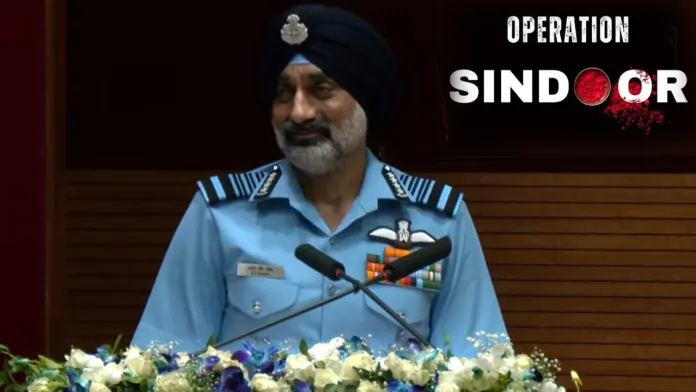

On Saturday, Indian Air Force (IAF) head Air head Marshal Amar Preet Singh made a big and never-before-seen announcement: the IAF shot down at least five Pakistani fighter jets and one major military plane during “Operation Sindoor” in May. This is the first time India has officially confirmed something like this since the armed crisis with its border earlier this year.
Operation Sindoor began on May 7 as a strong response to the April 22 terrorist incident in Pahalgam that killed 26 people. The Indian military attacked terrorist infrastructure in both Pakistan and Pakistan-occupied Jammu and Kashmir (PoJK). More than 100 terrorists from groups including Jaish-e-Mohammed, Lashkar-e-Taiba, and Hizbul Mujahideen died as a result. Pakistan responded with cross-border shelling and drone operations. India then launched a concerted counter-attack that damaged radar infrastructure, communication centers, and airfields at eleven of Pakistan’s airbases.
Here are five important things that the IAF chief said:
The IAF chief stated that a huge Pakistani military plane, likely an Airborne Early Warning and Control (AEW&C) or Electronic Intelligence (ELINT) plane, was shot down from a distance of 300 km. This is the longest surface-to-air kill ever. He said, “This is actually the largest ever recorded surface-to-air kill that we can talk about,” which shows how well India’s Russian-made S-400 air defense system works.
Air Chief Marshal Singh gave more information regarding the IAF’s precision attacks, saying that Sukkur and Sargodha airfields were hit. He displayed pictures of a destroyed UAV hangar, a damaged hangar that housed planes, including F-16s that were being worked on, and a radar station. Based on the satellite images, he said, “We have very clearly an aircraft inside where the attack took place.”
Evidence Made Public: The IAF chief said that Operation Sindoor was supported by both video and picture evidence that was made public. This is different from the 2019 Balakot airstrike. He said this helped “take care of the ghost of Balakot” and show the world what India has done, which was hard to do in the past.
Full Operational Freedom: Singh said that the operation was successful because the central government had “clear political will.” He said that the government gave the military the power to organize and carry out the operation “with no restrictions.” They employed self-imposed rules of engagement to keep things from getting out of hand.
Objective and Restraint: The head of the IAF declared that the only goal of the operation was to “teach terrorists a lesson.” Once that goal was reached and Pakistan wanted to calm things down, India used the chance to terminate the war, setting a “good example” by not letting things get worse and dragging on. He said that after 80 to 90 hours of fighting, Pakistan’s damage was so great that they contacted India’s Director General of Military Operations (DGMO) to start discussions.