

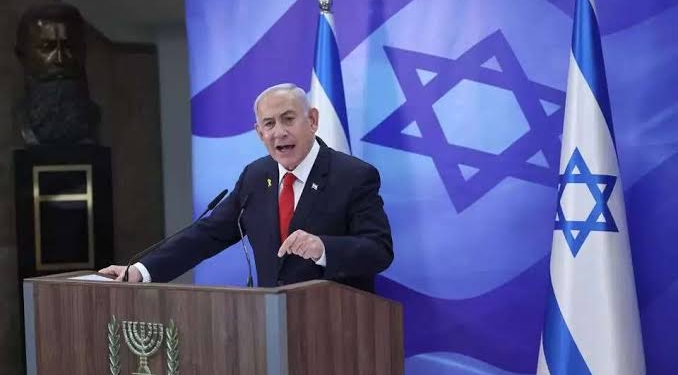

In a dramatic escalation of tensions in West Asia, Israeli Prime Minister Benjamin Netanyahu declared on Monday that Iran poses an “existential threat” not only to Israel but to the wider region and Europe, asserting that Israel’s ongoing military campaign seeks to neutralise that danger permanently.
Netanyahu made the statement while visiting the site of an Iranian missile strike that killed nine people. The Israeli leader said the country’s military operation—dubbed “Operation Roaring Lion”—was launched to eliminate threats emanating from Tehran.
Khamenei Killed in Coordinated Strikes
In a development that has sent shockwaves across global capitals, Israel and Iran reportedly launched coordinated strikes on Tehran and other cities on Saturday. According to Israeli claims, Iran’s Supreme Leader Ayatollah Ali Khamenei was killed during the operation, alongside several senior regime officials.
If confirmed, Khamenei’s death would mark one of the most consequential events in Middle Eastern geopolitics in decades.
‘Tyrants of Tehran Target Civilians’
Speaking at the missile impact site, Netanyahu drew a sharp contrast between Israeli military objectives and Iranian actions.
“This is the third day of Operation Roaring Lion,” he said. “The Israeli army and the state of Israel set out, with our great friends, the United States of America and President Trump, to thwart existential threats to Israel and great threats to America and the entire world.”
He accused Tehran’s leadership of deliberately targeting civilians. “When I stand here in a place that was bombarded by the terrorists in Tehran against innocent civilians, you see the difference. The tyrants of Tehran target civilians,” he said.
Netanyahu also dismissed speculation circulating online after Iran’s Islamic Revolutionary Guard Corps (IRGC) claimed it had launched a “surprise” ballistic missile strike targeting the Israeli Prime Minister’s office. His public appearance appeared aimed at countering rumours questioning his safety.
US Backs Israeli Offensive
The United States signalled strong support for Israel’s actions. US Secretary of Defense Pete Hegseth described the campaign as “a clear, devastating, decisive mission.”
He criticised Iran’s leadership, saying, “A regime that chanted ‘death to US and Israel’ was gifted death from US. Trump offered a pathway to peace, but Iran was not negotiating and buying time to restart nuclear ambitions and hold us hostage.”
Netanyahu reiterated that while Israel is targeting Iran’s regime, any potential regime change ultimately depends on the Iranian people. He warned that a nuclear-armed Iran would “threaten all of humanity,” arguing that Israel’s actions are protecting not only itself but many other nations.
India Expresses Concern, Calls for Restraint
Amid the rapidly deteriorating security situation, Indian Prime Minister Narendra Modi held a telephone conversation with Netanyahu to discuss the unfolding crisis.
Modi conveyed India’s deep concern over the escalating conflict and emphasised the protection of civilians as a top priority.
“Had a telephone call with PM Benjamin Netanyahu to discuss the current regional situation. Conveyed India’s concerns over recent developments and emphasised the safety of civilians as a priority. India reiterates the need for an early cessation of hostilities,” Modi posted on X.
Escalation Likely to Continue
On Sunday, Netanyahu vowed to intensify the offensive against Tehran, stating that Israeli forces would continue striking with increasing intensity.
“I have given instructions for the continuation of the campaign. Yesterday, we eliminated the tyrant Khamenei. Along with him, we eliminated dozens of senior figures of the oppressive regime. Our forces are now striking at the heart of Tehran with increasing intensity, and this will only continue to escalate further over the coming days,” he said.
As both nations exchange strikes and global powers react cautiously, fears of a broader regional war are mounting. With civilian casualties already reported and diplomatic efforts struggling to gain traction, the coming days are expected to be critical for West Asia and beyond.