

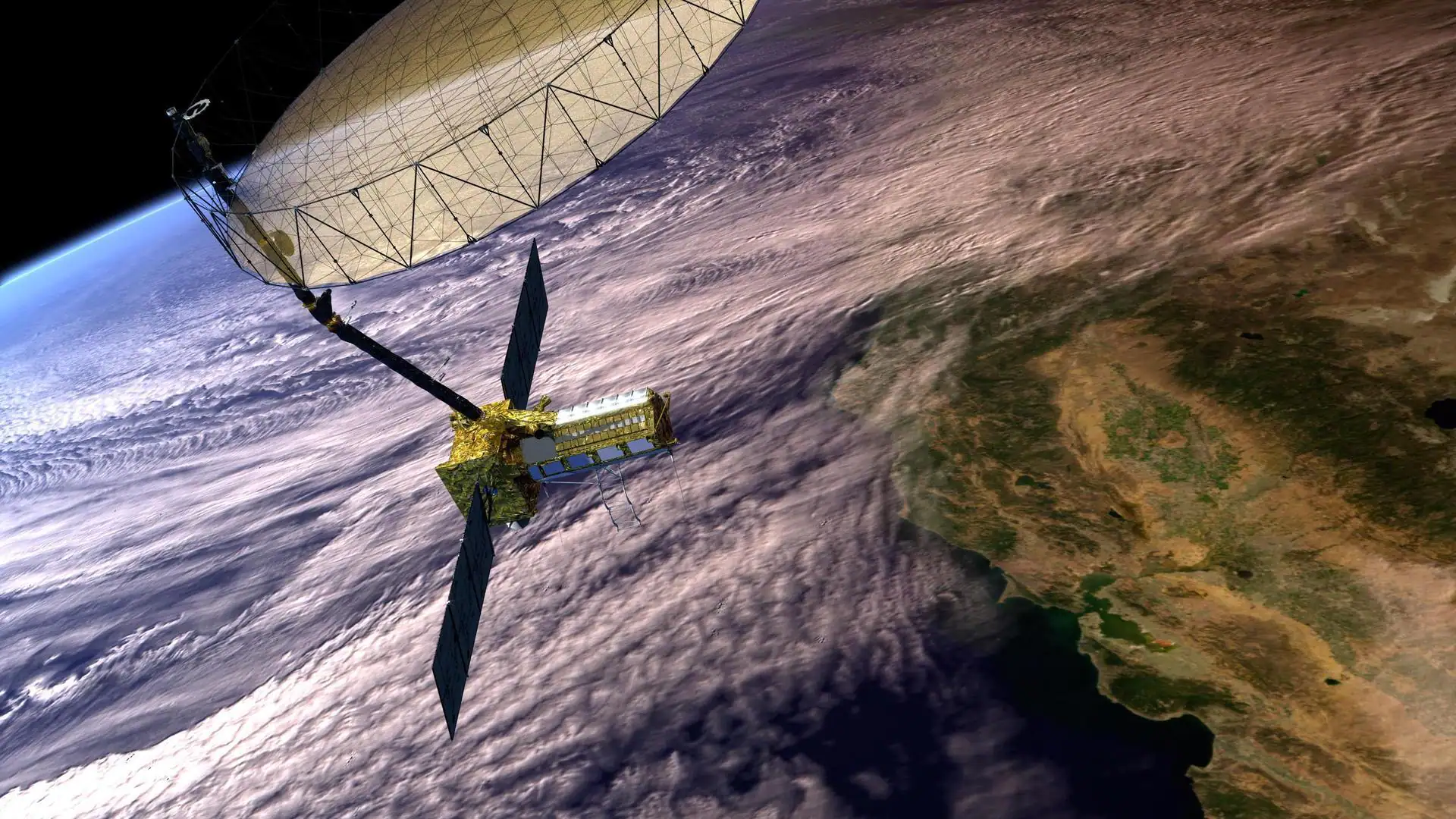

SRIHARIKOTA, INDIA – The Indian Space Research Organisation (ISRO) and the US National Aeronautics and Space Administration (NASA) worked together to launch the NASA-ISRO Synthetic Aperture Radar (NISAR) satellite on Wednesday, July 30, 2025. This was a major step forward for international space cooperation. This strong Earth observation satellite is made to keep an eye on even the smallest changes on the surface of our planet. It gives scientists, researchers, and disaster response teams important information that helps them comprehend climate change and predict natural disasters.
The NISAR satellite, which is about the size of a large SUV and weighs 2,393 kg, took off from ISRO’s Satish Dhawan Space Centre in Sriharikota, Andhra Pradesh, at 5:40 PM IST. It was carried by ISRO’s Geosynchronous Satellite Launch Vehicle (GSLV-F16) rocket. At 5:58 PM, it was successfully injected into its planned Sun-synchronous polar orbit, which is about 747 kilometers above Earth. This is a big deal because it’s the GSLV’s maiden trip to a Sun-synchronous polar orbit.
In the coming days, NISAR will start its complicated deployment sequence. It will extend its 30-foot boom and open up its 39-foot (12-meter) reflector, which is comprised of gold-plated wire mesh. By the end of October 2025, science operations should start.
Dual-Band Radar for Unmatched Detail
The $1.5 billion satellite will spend five years mapping almost all of Earth’s land and ice-covered areas. It has two powerful synthetic aperture radars (SARs): an L-band radar from NASA and an S-band radar from ISRO. These radars will always be on, scanning the Earth in great detail twice every 12 days. Experts say that the satellite is quite accurate and can find changes on the Earth’s surface that are only a centimeter wide. This is the first time a single Earth-observing satellite has been able to “see” through clouds, fog, and even thick vegetation, no matter what the weather is like or what time of day it is.
The L-band radar is great for measuring moisture levels and finding motion deep inside trees, sand, and ice. The S-band radar, on the other hand, is best at taking high-resolution pictures of agricultural land, cities, and coastal areas. This ability to work together gives us a better understanding of how the Earth works.
Changing how we study climate and deal with disasters
Scientists are going to change the way they study a world and climate that are changing quickly thanks to data from NISAR. The satellite will give us reliable information about:
Melting glaciers and polar ice sheets are very important for figuring out how sea levels are rising and how water moves throughout the world.
Changing groundwater supplies: Important for managing water resources.
Motion and stress of land surfaces: Helping to predict landslides and earthquakes by finding small changes in the ground.
Changes in forests and wetlands: Keeping an eye on changes that affect carbon dioxide and methane emissions, which are important for climate modeling.
Monitoring the health of crops and farms: Helping to make sure there is enough food.
Infrastructure monitoring: finding little changes in important assets like bridges and dams.
Union Minister Jitendra Singh called the joint launch India’s “scientific handshake with the world,” stressing that it could cut through fog, thick clouds, and ice layers. He called it a “pathbreaking enabler for the aviation and shipping sectors.”
ISRO Chairman V. Narayanan verified the successful launch by saying, “All the vehicle system performance is normal as expected and predicted.” We got to the right orbit today. We put it in orbit less than 3 km away, which is inside the 20 km limit.
Casey Swails, NASA’s Deputy Associate Administrator, was at the launch and praised the decade-long partnership. He said, “This is an incredible decade that has led to this moment through technical collaboration, cultural understanding, getting to know each other, building that team across continents and time zones, missing weekends with families and holidays.”
The NISAR mission shows how well NASA’s Jet Propulsion Laboratory (JPL) and ISRO’s Space Applications Centre in Ahmedabad worked together. JPL made the L-band radar, radar reflector antenna, deployable boom, and high-rate communication subsystem. ISRO’s Space Applications Centre in Ahmedabad made the S-band radar, and U R Rao Satellite Centre in Bengaluru made the spacecraft bus, launch vehicle, and mission operations.
The Alaska Satellite Facility (ASF) will have data from the L-band instrument, and the National Remote Sensing Centre in Hyderabad will have data from the S-Band instrument. NISAR will make the data it collects available for free to everyone across the world. This shows how open and collaborative this important scientific project is.