

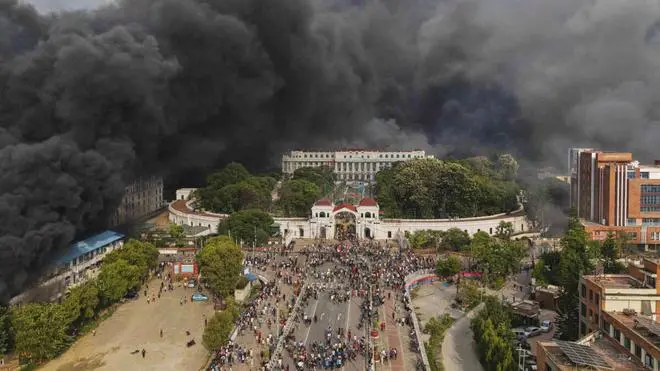

Kathmandu, Nepal: Nepal has plunged into a state of political uncertainty after Prime Minister KP Sharma Oli’s resignation amid a wave of furious anti-corruption protests. The demonstrations, which began after the government imposed a sweeping social media ban, escalated into a violent and deadly movement that has left at least 19 people dead, many of them students.
This crisis is the most severe challenge to Nepal’s fragile democracy since the monarchy was abolished in 2008. The unrest has laid bare a deep and widening chasm between the country’s long-entrenched political elite and its restless, disillusioned youth. The coming weeks will be critical as Nepal’s leaders grapple with the choice between negotiating a constitutional transition, managing ongoing instability, or heading toward new elections under an interim government.
The Spark that Ignited the Unrest
The protests gained momentum after the government blocked more than two dozen social media platforms, including Facebook, X (formerly Twitter), and YouTube. Officials accused the companies of failing to register and comply with government oversight, but the move was widely seen as an attempt to stifle dissent. What began as anger over censorship quickly evolved into a broader movement reflecting deep-seated frustrations. Young Nepalis, often referred to as Gen Z, took to the streets to protest widespread corruption, nepotism, and a lack of economic opportunity that forces thousands to seek jobs abroad daily.
By Tuesday, the demonstrations had turned violent. Protesters stormed government buildings, including the federal parliament, the presidential house, and the prime minister’s office, setting them on fire. In a shocking display of public anger, mobs also attacked politicians, with Foreign Minister Arzu Rana Deuba and her husband, former Prime Minister Sher Bahadur Deuba, reportedly beaten.
Current Situation and Next Steps
With Prime Minister Oli’s resignation accepted by President Ram Chandra Poudel, the country is currently operating under a caretaker government. However, Oli’s whereabouts remain unclear, and he has not been seen in public since the protests began. In a bid to restore order, the military has taken control of Kathmandu, enforcing curfews and firing warning shots to prevent further looting and prison breaks. The army has called for protesters to form a negotiation team, but with the movement being leaderless and decentralized, it is unclear who represents the crowds.
According to Nepal’s 2015 constitution, there is a clear process for forming a new government. The president must first invite the party with a parliamentary majority to form a government. If no single party can command a majority, any member who can prove they have a majority may be appointed. If all attempts fail, parliament can be dissolved and fresh elections held. The challenge, however, is that many established party leaders are now discredited in the eyes of the protesters, raising doubts about whether the traditional constitutional route will be accepted by the public.
The Rise of Outsider Candidates
As the protests continue, two figures from outside the traditional political establishment have emerged as potential leaders:
- Balendra Shah (Balen Shah): The 35-year-old mayor of Kathmandu and former rapper is widely admired for his anti-corruption stance and youth-friendly appeal. His rise symbolizes the desire for a new kind of political leadership.
- Rabi Lamichhane: A former TV journalist and founder of the Rastriya Swatantra Party, Lamichhane was freed from prison by protesters on Tuesday, where he was awaiting trial on financial misconduct charges. He is seen as a charismatic figure who challenges the old political order.
The demand for a new political system is also growing louder. Some protesters are calling for a complete rewriting of the 2015 constitution, arguing that the existing political class cannot be trusted to lead meaningful reforms. What happens next will depend on whether the political establishment can engage with the protesters and address their grievances, or if the standoff deepens, pushing the country into prolonged instability.