

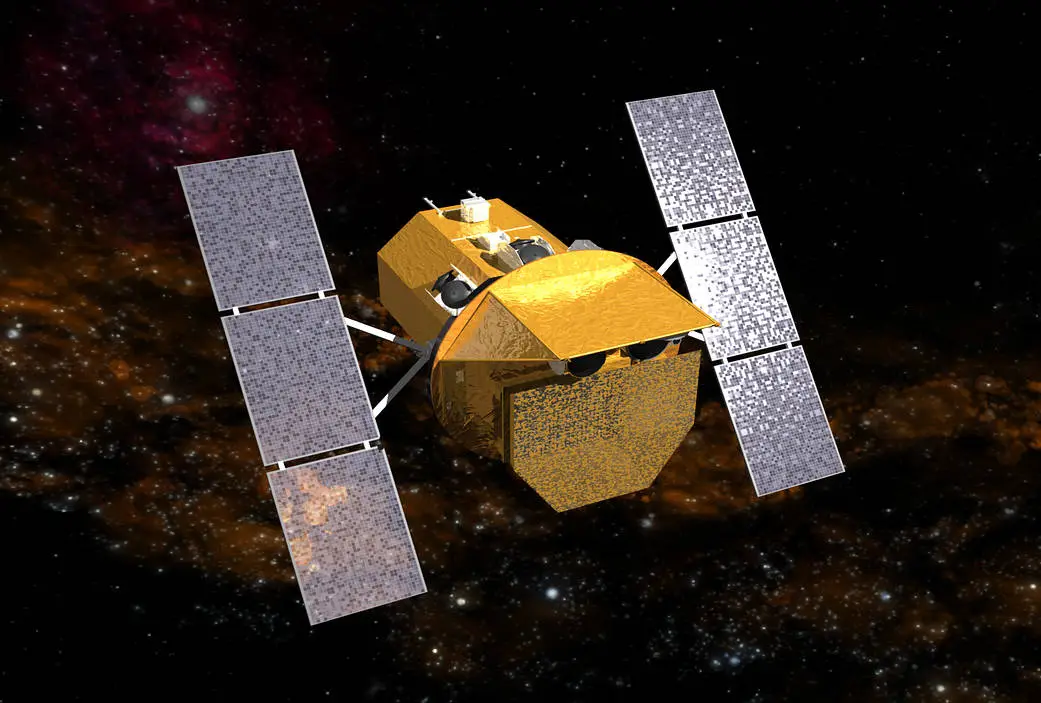

An ageing spacecraft operated by NASA is gradually losing altitude and drifting towards Earth due to intensified solar activity, prompting the agency to initiate a high-stakes rescue mission worth $30 million.
The spacecraft in question, the Neil Gehrels Swift Observatory, has been a cornerstone of space research for over two decades, helping scientists study powerful cosmic phenomena such as gamma-ray bursts, black holes and supernovae.
Why the Spacecraft Is Falling
The issue stems from heightened solar activity, which heats Earth’s upper atmosphere and causes it to expand outward. This expansion increases atmospheric drag on satellites in low Earth orbit, gradually pulling them closer to the planet.
Earlier this year, NASA had already scaled back the observatory’s scientific operations to reduce drag and slow its orbital decay. The move allowed mission controllers to maintain a more stable orientation, buying valuable time.
Despite these efforts, Swift’s orbit has continued to decline. Its average altitude dropped from around 400 km to below 300 km, raising concerns about an uncontrolled re-entry.
Private Startup to Lead Rescue Effort
To avert a potential loss, NASA has awarded the contract to Katalyst Space Technologies to carry out a complex orbital “reboost” mission.
The plan involves:
- Launching a Pegasus rocket from an aircraft
- Deploying a robotic spacecraft
- Autonomously docking with Swift
- Boosting it to a higher, more stable orbit
If successful, the mission could extend the observatory’s life by up to 10 years.
Race Against Time
Scientists say the mission’s success depends on maintaining Swift above a critical altitude before the rescue launch, expected this summer.
S. Bradley Cenko, principal investigator at NASA’s Goddard Space Flight Center, said operational adjustments are already underway to maximise the mission’s chances.
Reports suggest that without intervention, the spacecraft could burn up in Earth’s atmosphere within months.
Why Swift Matters
The Neil Gehrels Swift Observatory has played a crucial role in advancing our understanding of the universe. Its ability to quickly detect and study gamma-ray bursts has made it one of the most important observatories in modern astrophysics.
Losing it would create a significant gap in ongoing research into some of the most energetic and mysterious events in space.
A Milestone for Space Operations
Beyond saving a single spacecraft, the mission could mark a breakthrough in satellite servicing technology. Autonomous docking and orbital boosting, if executed successfully, may pave the way for extending the lifespan of ageing satellites and reducing space debris.
With the clock ticking, the rescue of Swift represents both a scientific necessity and a technological challenge for NASA and its private-sector partner.