

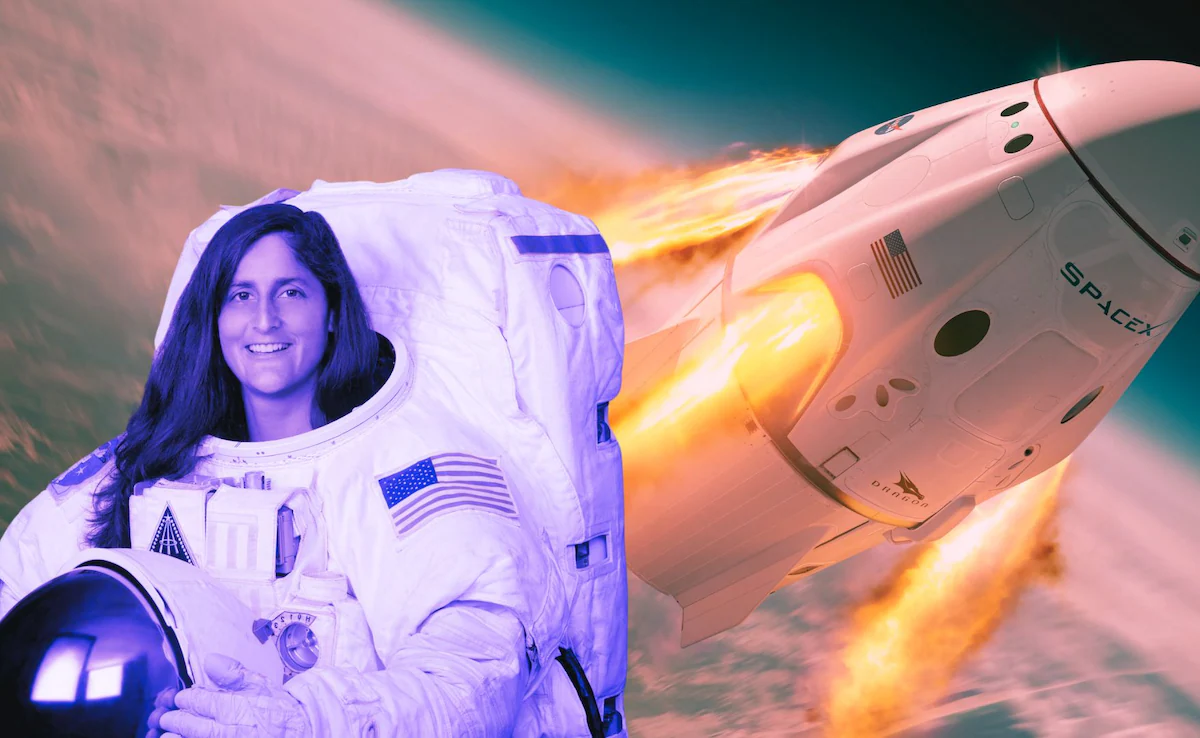

New Delhi: NASA astronaut Sunita Williams, whose planned 10-day mission aboard the International Space Station (ISS) stretched into an extraordinary nine-and-a-half months, has officially retired after a 27-year career with the US space agency. NASA announced on Tuesday that her retirement took effect on December 27, 2025, just after last Christmas.
Williams’ final mission marked one of the most talked-about spaceflights in recent years, underlining her resilience and leadership during extended stays in orbit.
NASA Hails a ‘Trailblazer in Human Spaceflight’
Paying tribute to Williams, NASA Administrator Jared Isaacman praised her pivotal role in shaping modern space exploration.
“Suni Williams has been a trailblazer in human spaceflight, shaping the future of exploration through her leadership aboard the space station and paving the way for commercial missions to low Earth orbit,” Isaacman said.
He added that her work laid the groundwork for NASA’s Artemis missions to the Moon and future journeys to Mars, calling her achievements an inspiration for generations to come.
608 Days in Space Across Three Missions
Selected by NASA in 1998, the Indian-origin astronaut logged a total of 608 days in space over three space missions, ranking second among NASA astronauts for cumulative time spent in orbit.
She also ranks sixth for the longest single spaceflight by an American, tied with astronaut Butch Wilmore, with both spending 286 days in space during NASA’s Boeing Starliner and SpaceX Crew-9 missions.
Record-Breaking Spacewalks and Historic Firsts
Williams completed nine spacewalks, totalling 62 hours and 6 minutes, the most by any female astronaut and fourth on NASA’s all-time list.
She also made history as the first person to run a marathon in space, further cementing her reputation as one of NASA’s most accomplished astronauts.
Three Space Missions Over Nearly Two Decades
First Mission (2006–07)
Williams made her space debut on December 9, 2006, aboard Space Shuttle Discovery (STS-116). As part of Expedition 14/15, she served as a flight engineer and set a then-world record by completing four spacewalks totalling 29 hours and 17 minutes.
Second Mission (2012)
Her second spaceflight launched on July 14, 2012, from Baikonur Cosmodrome, Kazakhstan, as part of Expedition 32/33. During the 127-day mission, she served as ISS commander for Expedition 33 and conducted three spacewalks to repair critical station hardware, including a radiator leak and solar power components.
Final Mission (2024–25)
Williams’ final mission began in June 2024, when she and Butch Wilmore launched aboard Boeing’s Starliner spacecraft for NASA’s Crew Flight Test. The mission extended far beyond its planned duration, with both astronauts joining Expedition 71/72. Williams once again took command of the ISS during Expedition 72, completed two spacewalks, and returned to Earth in March 2025 aboard SpaceX’s Crew-9 mission.
Strong Indian Roots
Sunita Williams’ father, Deepak Pandya, was a neuroanatomist born in Jhulasan village in Gujarat’s Mehsana district, before migrating to the United States. Her mother, Bonnie Pandya, is of Slovenian origin.
Born in Euclid, Ohio, Williams considers Needham, Massachusetts, her hometown. She and her husband, Michael Williams, enjoy spending time with their dogs, fitness training, hiking, camping, and working on houses, cars, aeroplanes and outdoor projects.
‘Space Is My Absolute Favourite Place to Be’
Reflecting on her career, Williams said space would always hold a special place in her heart.
“Anyone who knows me knows that space is my absolute favourite place to be,” she said.
“It’s been an incredible honour to have served in the Astronaut Office and to fly in space three times.”
She credited her long career to the support of her colleagues and said the ISS, its people, engineering and science have made humanity’s next steps toward the Moon and Mars possible.
“I am super excited for NASA and its partner agencies as we take these next steps, and I can’t wait to watch the agency make history,” she added.