

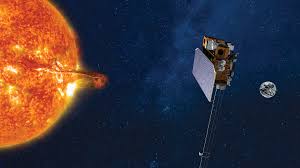

NASA and the National Oceanic and Atmospheric Administration (NOAA) are working together to launch three new spacecraft. The goal is to keep an eye on how the Sun affects our solar system and keep Earth safe from space weather. The missions—NASA’s Interstellar Mapping and Acceleration Probe (IMAP) and the Carruthers Geocorona Observatory, as well as NOAA’s Space Weather Follow On-Lagrange 1 (SWFO-L1)—are all set to fly on a SpaceX Falcon 9 rocket in late September 2025.
The three spacecraft will travel to the Sun–Earth L1 point, which is a stable place in space roughly a million miles from Earth. From this point of view, they will always be able to see the solar wind and space weather as it moves away from the Sun. This will allow them give important early warnings of solar storms that could affect satellites, electrical grids, and airline flights.
Mapping the Heliosphere and the Atmosphere of Earth
NASA says that the IMAP spacecraft will be a “celestial cartographer” that will investigate the heliosphere, which is a huge bubble of solar wind that surrounds our solar system. The main purpose of the project is to study how this bubble interacts with interstellar space. This will help us learn more about how the heliosphere protects our solar system from galactic cosmic radiation and makes it a place where life may thrive.
The Carruthers Geocorona Observatory, a tiny telescope, will also record ultraviolet light from the exosphere, which is the outermost layer of Earth’s atmosphere. Carruthers will help scientists learn more about how the Sun changes the density, size, and form of the exosphere by seeing it from L1. To predict how solar storms will affect communications, power, and satellite systems, we need this information. Dr. George Carruthers, a pioneer in ultraviolet astronomy, is honored with the name of the mission.
NOAA’s Space Weather Sentinel
NASA’s missions are mostly for study, but NOAA’s SWFO-L1 is an operational satellite that watches space weather all the time. It will take pictures of the Sun’s corona and samples of the solar wind all the time because of where it is. This will help it find strong eruptions, such coronal mass ejections (CMEs), long before they get to Earth.
SWFO-L1 will send real-time data to forecasters, giving utilities, airlines, satellite operators, and astronaut teams important time to take safety measures. This early warning is necessary to keep important infrastructure safe from the harmful consequences of solar storms.