


The “Invisible Glue” of the Universe: Dark Matter
NASA calls dark matter the “invisible glue” that keeps the universe together. It is still one of science’s biggest mysteries. You can’t see it directly, yet its gravity changes galaxies, stars, and other cosmic structures all around the cosmos.
Scientists are sure that dark matter exists, but no one has ever seen it directly. This means that fresh theories and proof can still be found.
A Strange Gamma-Ray Glow in the Milky Way
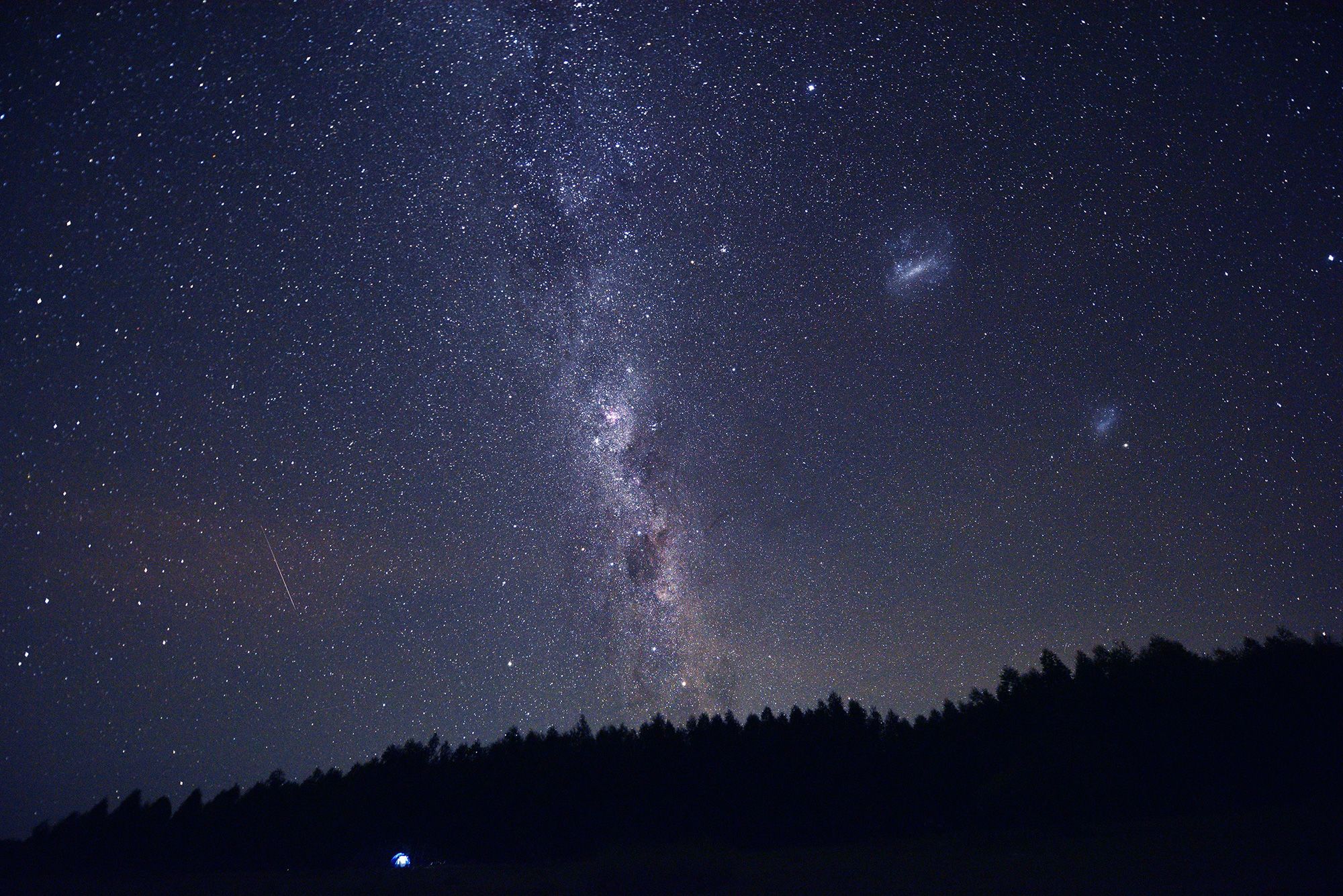
Astronomers have been interested in an unusual glow of gamma rays in the heart of the Milky Way for more than ten years. Astrophysicists throughout the world are still interested in the glow, which was first seen shortly after NASA’s Fermi Gamma-ray Space Telescope launched in 2008.
There are two basic ideas about what might be going on:
Dark matter particles crashing into each other and breaking apart, which sends out gamma rays as a side effect.
The glow comes from unobserved millisecond pulsars, which are fast-spinning neutron stars that give out gamma rays.
The dispute has gone on because both ideas fit the evidence rather well. But many scientists thought that dying stars might be the reason because the glow’s form matched the bulge of the Milky Way, which is a congested area full with old stars.
New Research Makes a Strong Case for Dark Matter
A new study in Physical Review Letters adds an interesting twist to the mystery. Researchers used advanced supercomputer simulations to show that collisions between dark matter might also cause a bulge-shaped gamma-ray glow, precisely like the one seen at the center of the galaxy.
“Dark matter is the most important thing in the universe and keeps galaxies together.” “It’s very important, and we’re always coming up with ideas for how to find it,” said Professor Joseph Silk, who helped write the paper at Johns Hopkins University, the Institut d’Astrophysique de Paris, and Sorbonne University.
“Gamma rays, and more specifically the extra light we see at the center of our galaxy, could be our first clue.”
The study says that if the extra gamma light isn’t originating from dying stars, it could be the first concrete proof that dark matter exists.
One Step Closer to Solving the Cosmic Puzzle
The Fermi Gamma-ray Space Telescope has painstakingly mapped this extra light, which proves that something strange is going on at the center of the Milky Way. Dark matter’s presence is supported by its effect on visible matter’s gravity, but finding it directly has been one of the hardest problems in modern physics.
Researchers found that both dark matter interactions and pulsar activity suit the gamma-ray data well, which means that more precise measurements are needed to find out where they really come from.
The truth may be revealed by next-generation telescopes.
Scientists are hoping that the new Cherenkov Telescope Array Observatory (CTAO), which is being built in Chile and Spain, will make the big discovery they need. It should be able to tell the difference between gamma-ray emissions from pulsars and dark matter collisions once it is up and running, which is projected to happen by 2027.
If the new telescope supports the dark matter theory, it would be one of the most important discoveries in the history of astrophysics. It would provide people their first firsthand proof of the invisible stuff that makes up the cosmos.