

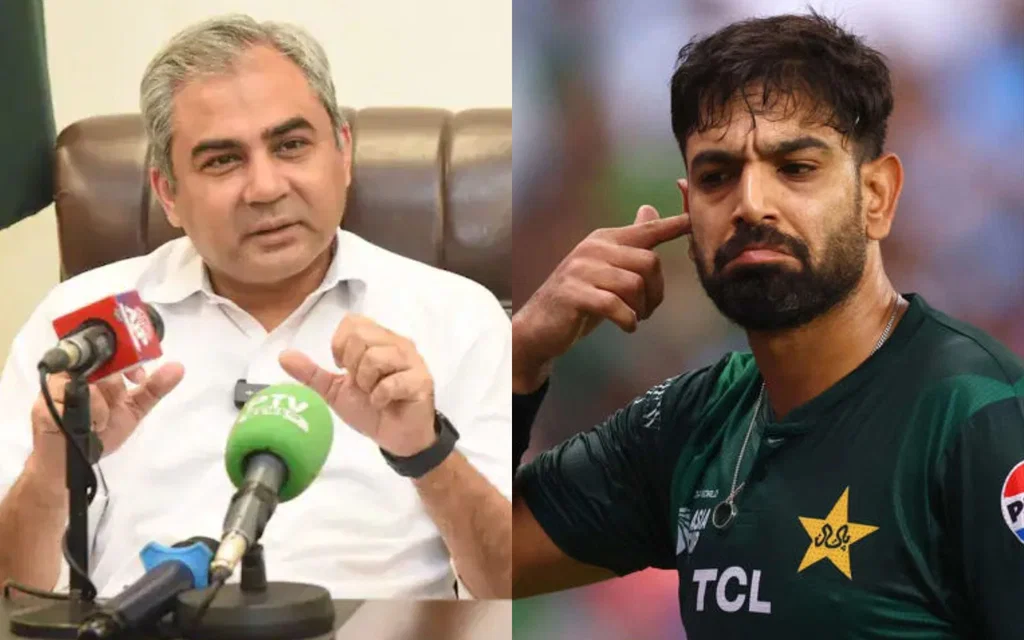

The India-Pakistan cricket rivalry has gotten so bad that the Pakistan Cricket Board (PCB) Chairman and head of the Asian Cricket Council (ACC), Mohsin Naqvi, has reportedly decided to pay the fine for fast bowler Haris Rauf himself. Rauf lost 30% of his match costs recently for using “abusive language” and making provocative gestures during the very heated Super 4s match versus India, their biggest adversary. Many people consider this personal pledge from a high-ranking official, who is also Pakistan’s Interior Minister, as a strong but contentious show of support for the player’s on-field actions, even though the International Cricket Council (ICC) said they were against the rules.
The Board of Control for Cricket in India (BCCI) filed a formal complaint about the behavior of Rauf and his teammate Sahibzada Farhan, which led to the punishment. During the game, Rauf was spotted making motions that made fun of Indian spectators by referring to falling planes, which is a politically charged and incendiary conduct, as well as giving a harsh send-off following a wicket. Sahibzada Farhan, his teammate, also came under fire for his gunfire-mimicking celebration after scoring fifty in the same game. On Friday in Dubai, both cricketers went to a hearing with Match Referee Richie Richardson. They both said they were “not guilty” of the allegations. Rauf got a fine, but Farhan got a warning for his celebration, which shows how different the two actions were in terms of how serious they were.
The whole thing is full of complaints going back and forth, which shows the political side of the debate. The PCB then filed an official complaint against India’s captain, Suryakumar Yadav, for what they called “political remarks.” Yadav’s crime was saying that India’s September 14 triumph was for the victims of the Pahalgam terror attack and the Indian Armed Forces. The PCB said this broke the code of conduct since it brought politics into the sport. Yadav also said he was innocent, but he was fined 30% of his match fee and told not to make any more political statements for the rest of the Asia Cup. The PCB Chief’s extraordinary personal intervention, which effectively canceled the financial penalty for breaking the code of conduct, adds a final, very dramatic layer to what has become one of the most controversial sporting events in recent memory. The bitter rivals will meet again in the tournament’s final on Sunday, September 28.