

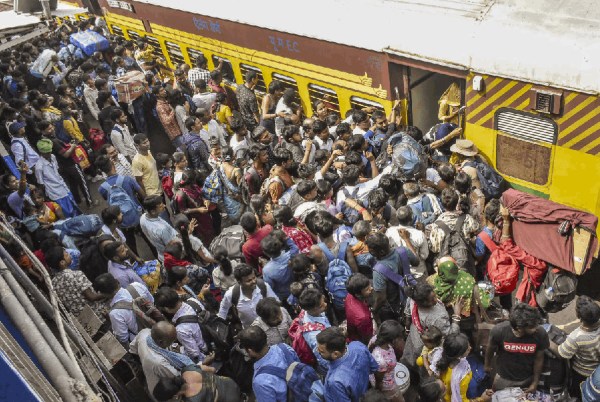

The settlements in Mithilanchal, a region noted for its long-term out-migration, have changed in a shocking way. Suddenly, places along important roads like the Darbhanga-Baheri road (Dekuli, Madanpur, Ughra, Usmamatha, Shankar Lohar, and Pator) and the Darbhanga-Supaul road (Kakarghati, Tarsarai, Sakri, Nawada, Aradiya-Sangram, and Phulparas) are very busy. The strange accents and faces that now fill these once-empty sites don’t belong to people from outside the area; they belong to the area’s own sons and daughters who are coming home from jobs across the country.
The annual trip is a common sight, propelled by the strong cultural pull of Chhath, a celebration that makes every Bihari feel nostalgic. According to Dekuli resident Madan Kumar Jha Madhup, “Every year, Chhath brings with it a spontaneous and happy reverse migration.” The Indian train becomes the Bihar rail. But as soon as the event is over, people have to move again, and these homes and villages are once again quiet and empty.
This year, though, the journey has become very political. The Bihar assembly elections are coming up right after Chhath, and the migrant population, which is generally “ignored,” has become a very important voting group. Political parties, such as the NDA and its opponents, are trying hard to win over these returnees. Parties have set up everything from cars and buses to get them to their villages on time to meal packets, which is a clear evidence of how important they are now that they are in politics. Party activists can be seen at all the main train and bus stations, not merely to welcome people back, but also to get them to vote for their candidates.
The Real Life of the Migrant Voter
The main issue that returning migrants think about when they vote is the ongoing lack of jobs and industries in Bihar. This dilemma made them look for work elsewhere when they were teenagers.
Sanjay Kumar, 42, is a non-resident Bihari from the Kumhar caste in Alinagar, Darbhanga. He works in another state and says, “Modiji hi kar sakte hain, Nitishji hi kar sakte hain lekin kab karenge pata nahin” (Only Modi ji can do it, only Nitish ji can do it, but when, we don’t know). It’s clear that he’s in a tough spot; he doesn’t know if he’ll even stay to vote because he’s anxious about getting back to Tamil Nadu for work.
But some migrants are sure of their choice, thanks to a mix of trust, development, and social welfare programs. Sudhir Malakar, 42, who works in a diamond industry in Surat, says he will vote for the NDA because he trusts Prime Minister Modi. He does, however, have something negative to say. He is disappointed that no party has a clear plan for industrial and overall growth, saying, “These welfare programs are making us dependent.” These are free things.
The Jan Suraaj Factor and the Women’s Vote
People clearly want change, yet the current Chief Minister Nitish Kumar still gets a lot of support from women, who are his main supporters. Manoj Sahani from Kamalpur village, who is coming back from Ambala, says that even though he wants to vote for the new alternative, Jan Suraaj, his wife is “adamant about voting for Nitishji.” She says this is because the CM raised his mother’s old-age pension from ₹400 to ₹1,000. Sahani, who fled home 25 years ago, says that things have changed in Bihar, such better roads and electricity, but he still wants jobs.
On the other hand, some migrants are still stuck in identity politics from decades ago. Mohammad Musa, 55, a driver in Kolkata, says he will vote for the RJD even though he admires political strategist Prashant Kishor. He says, “I can’t go beyond my jamaat (community).” “We’ll vote for Tejashwi because he looks like another Lalu.”
The rise of Jan Suraaj, led by Prashant Kishor, is a big new thing. Dinesh Mahto, 42, who works in construction in Pune, is very angry with both the RJD and the NDA for not helping migrants. He will vote for Jan Suraaj because “Prashant Kishor has made migration an issue.”
People in the belt like welfare programs like free food grains and cash transfers of ₹10,000 to women’s accounts. These are expected to help the NDA. People keep asking for the Nitish-Modi coalition to stop focusing on welfare politics and start working on bigger issues like development.
The Race to Keep People from Voting
Priya Darshan, a political analyst from Patna, says that the main drama of this election is the “possible exodus of migrant voters after the Chhath festival.” There are more than 4.6 million Biharis working in other states and another 2.17 lakh working abroad. Because of this, the usual rush after the festival could make voter turnout drop a lot in some areas.
Darshan says, “All the parties have started doing things to get the votes of migrant workers’ families by any means necessary, including socializing, threatening, and bribing.” He said, “Whoever keeps their migrant supporters home will have a big advantage.” This year’s Chhath in Bihar will be more about politics than religion. The NDA is now thought to have an advantage in attracting this important group since it has more resources.
This election is taking place against the backdrop of the migration issue, which is causing the most people to leave districts like Patna, East Champaran, Siwan, Muzaffarpur, and Darbhanga, especially among the Extremely Backward Classes (EBCs) and Scheduled Castes. The silent trips of these migrant voters who are coming back and leaving, and whether they stay to vote, may decide the fate of Bihar’s future administration.