

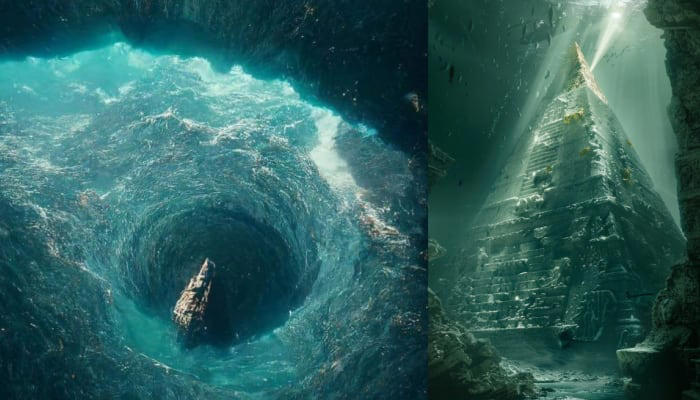

Scientists have made a groundbreaking geological discovery deep beneath the Bermuda Triangle, a region of the Atlantic Ocean long associated with mysterious ship and aircraft disappearances. Researchers have identified a massive rock layer nearly 12.4 miles (20 kilometres) thick, unlike anything found elsewhere on Earth, according to a report by Live Science.
The Bermuda Triangle lies between Florida, Puerto Rico, and Bermuda, and while its reputation has often been shaped by myths and legends, the latest discovery is firmly rooted in science. The findings come from a study conducted by researchers at Carnegie Science and Yale University, who used seismic data from earthquakes to map the Earth’s interior beneath Bermuda.
An unexpected layer beneath the crust
The study, published in the journal Geophysical Research Letters, reveals that the newly identified rock layer sits between the oceanic crust and the tectonic plate—a location where scientists would normally expect to find the mantle.
“Typically, you have the bottom of the oceanic crust, and then it would be expected to be the mantle,” said William Frazer, the study’s lead author and a seismologist at Carnegie Science in Washington, D.C.
“But in Bermuda, there is this other layer that is emplaced beneath the crust, within the tectonic plate that Bermuda sits on.”
The layer is unusually thick and low in density, suggesting it does not conform to standard geological models of oceanic islands.
Linked to ancient volcanic activity
Researchers believe the structure may be a remnant of ancient volcanic processes, possibly dating back to the time when the supercontinent Pangea began breaking apart millions of years ago. Though Bermuda has no recent volcanic activity, this buried material may still be influencing the region’s geology.
The discovery could explain the mysterious oceanic swell beneath Bermuda, where the seafloor is elevated by about 1,640 feet (500 metres) compared to surrounding areas—something that has puzzled scientists for decades.
Why Bermuda stands taller than expected
“There is still this material that is left over from the days of active volcanism under Bermuda that is helping to potentially hold it up as this area of high relief in the Atlantic Ocean,” said Sarah Mazza, a geologist at Smith College in Massachusetts, who was not involved in the study.
This challenges traditional theories that volcanic islands only remain elevated due to active or recently active magma sources.
Implications for Earth’s geological history
The findings raise broader questions about whether similar hidden structures exist beneath other oceanic islands. Scientists now plan to examine seismic data from elsewhere in the world to determine if Bermuda is truly unique or part of a larger, previously unrecognised geological pattern.
“Understanding a place like Bermuda, which is an extreme location, is important to understand places that are less extreme,” Frazer said.
“It gives us a sense of what are the more normal processes that happen on Earth and what are the more extreme processes that happen.”
If similar formations are found elsewhere, the discovery could rewrite parts of Earth’s geological history and reshape how scientists understand volcanic island formation.