


For decades, planetary scientists have tried to solve one of Mars’ greatest mysteries: where did all its water go? Rover missions like NASA’s Perseverance and Curiosity have confirmed that Mars once had rivers, lakes, and possibly oceans. Yet today, the Red Planet is a frozen, barren desert.
A new international study has identified a surprising mechanism behind this dramatic transformation. Researchers have discovered that powerful dust storms, dubbed “rocket storms,” act like elevators, pushing water vapor high into the Martian atmosphere, where it is destroyed and lost to space forever.
How Mars Loses Water
On Earth, the water cycle is relatively stable. On Mars, however, conditions are far more extreme due to its thin atmosphere and elongated orbit around the Sun.
Scientists track Mars’ water history using the Deuterium-to-Hydrogen (D/H) ratio, a key indicator of how much water has escaped. Hydrogen is lighter than deuterium, so when sunlight breaks apart water molecules, hydrogen escapes into space more easily. Over time, this increases the D/H ratio, revealing how much water the planet has lost.
Previously, researchers believed most water loss occurred during Mars’ southern summer, when the planet is closest to the Sun and solar radiation is strongest.
The Surprising Discovery: Year-Round Water Escape
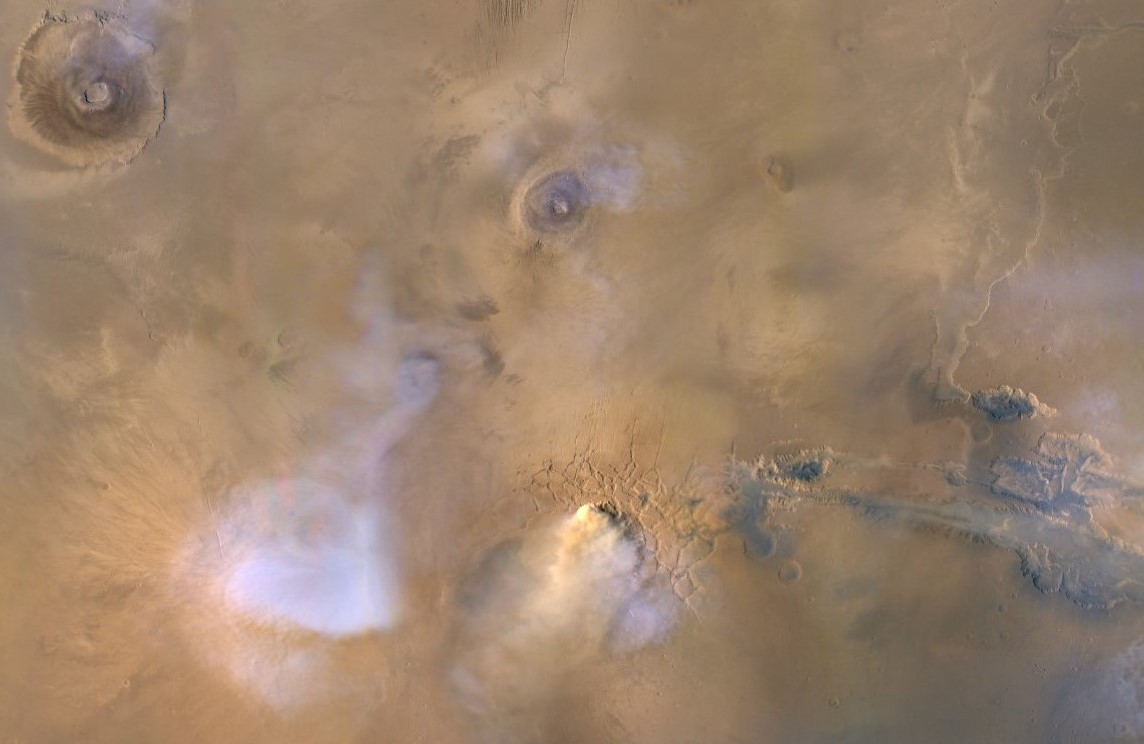
New data from the ExoMars Trace Gas Orbiter, the Emirates Mars Mission, and NASA’s Mars Reconnaissance Orbiter challenged this assumption. Scientists observed a massive dust storm during Mars’ cooler northern summer in 2022, a time when water loss was thought to be minimal.
The study found that dust storms heat the middle atmosphere by about 15°C, preventing water ice clouds from forming. Normally, these clouds trap moisture at lower altitudes. Without them, water vapor is pushed upward into the upper atmosphere.
Once there, intense ultraviolet radiation breaks the water molecules apart, and the lightweight hydrogen atoms are swept away by solar winds into space.
A Missing Piece in Mars’ Evolution Puzzle
This discovery suggests that Mars has been losing water throughout the year for billions of years, not just during seasonal peaks. Over geological timescales, this constant loss could explain how Mars transformed from a planet with deep oceans into the dry, inhospitable world we see today.
Scientists say this finding fills a crucial gap in understanding Mars’ climate evolution and could also help researchers study water loss on other planets, including exoplanets.