

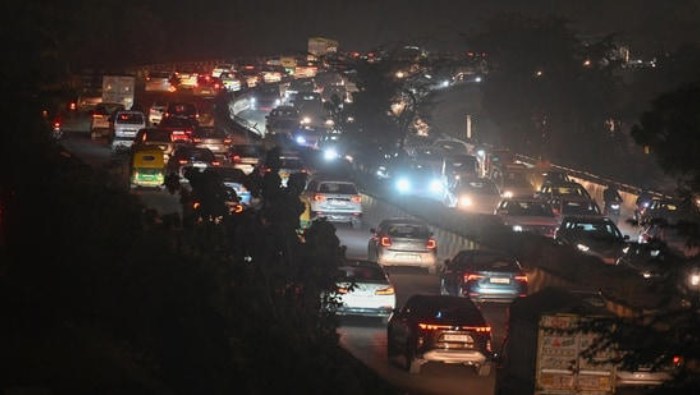

NEW DELHI — As the capital prepares to host global tech giants and world leaders for the AI Impact Summit (Feb 16–20), the city’s traffic infrastructure is teetering on the edge of collapse. Data accessed by Hindustan Times reveals a “crisis of the department’s own making,” as the Delhi Traffic Police grapples with a massive manpower deficit that has left major intersections like ITO, Ring Road, and NH-48 essentially unmanned.
1. The Math of a Meltdown: Where are the Cops?
On paper, Delhi has thousands of traffic personnel. On the road, the numbers tell a different story. The staggering vacancy rate means that for every five sanctioned positions, only four are filled—and of those, a significant portion is diverted away from the streets.
- Sanctioned Strength: 6,102 personnel
- Actual Strength: 4,901 personnel (20% Vacancy)
- The “Effective” Force: After accounting for leaves (~500), VIP duties (~500), and special deployments at pollution checkpoints or court hearings, only about 2,500 personnel are available to manage 1,800km of roads and 1,527 traffic signals.
2. Commuter Nightmare: A Week of Gridlock
This week, despite clear weather and routine weekday volumes, Delhi’s arteries witnessed “predictable” chaos.
- The ITO Choke: Commuters reported spending up to 2 hours to cross the ITO-South Extension stretch.
- NH-44 / National Expressways: Users on social media slammed the “National Expressway” status, noting it took 30 minutes to cover just 3km on Thursday morning.
- The Unmanned Palam Flyover: Resident grievances on X (formerly Twitter) highlighted a complete absence of traffic police at critical junctions during peak hours.
3. The AI Impact Summit (Feb 16–20): Bracing for “Hellish” Traffic
With the summit kicking off next week at Bharat Mandapam, the city is bracing for unprecedented route closures.
4. Hotspot Fixes: Plans vs. Reality
In December, the police identified 62 chronic choke points, promising “engineering fixes” and “junction redesigns.” Earlier this week, the Delhi government repackaged this as a 215-point action plan. However, experts like S. Velmurugan of CSIR-CRRI warn that press releases don’t fix jams.
“When people have to pay a congestion surcharge to commute, they might stop taking personal vehicles. But until staffing is addressed, these plans remain stuck in bureaucratic aspic.”