

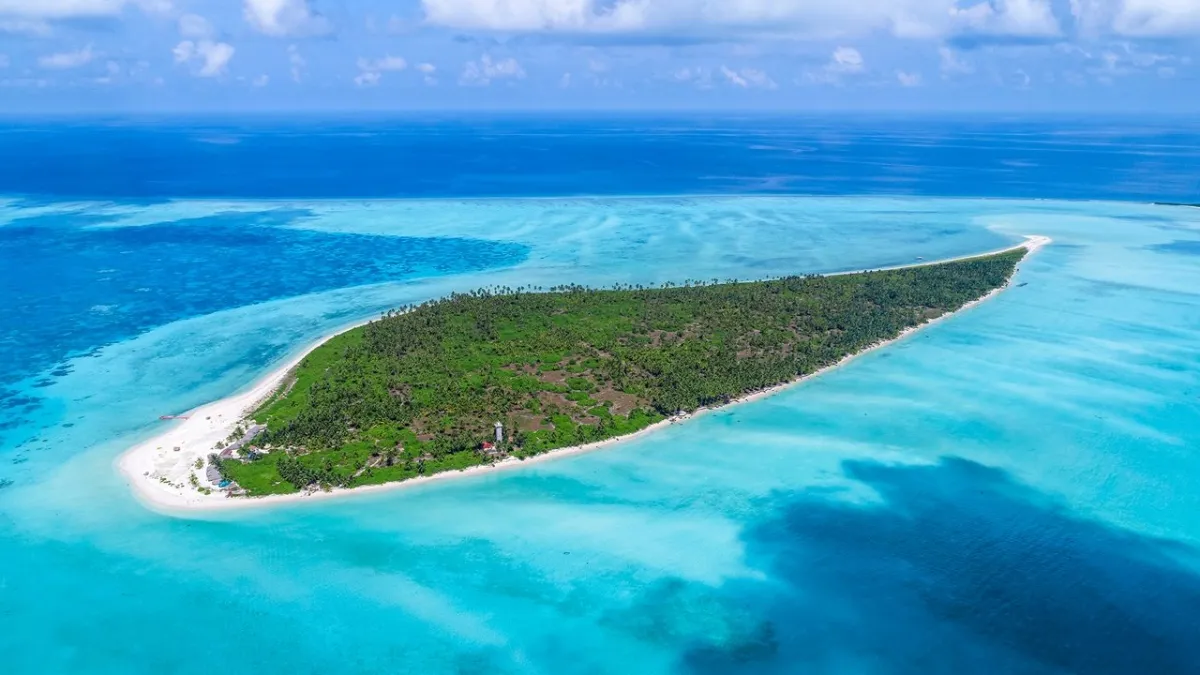

The Lakshadweep administration has initiated a plan to acquire Bitra Island, a tiny yet strategically significant island in the Union Territory, for transfer to defence and strategic agencies of the Government of India, according to a notification issued on July 11 by the territory’s department of revenue.
The move has alarmed the island’s 350-odd residents, many of whom belong to scheduled tribes and depend entirely on fishing and coconut farming for survival.
“The initiative is necessitated by the strategic location of the island, its national security relevance, and the inherent logistical and administrative challenges associated with civilian habitation,” reads the government notice.
Island’s Geography and Significance
Though Bitra Island itself spans just 0.091 sq km, it is surrounded by a 45 sq km lagoon, which is a crucial fishing ground for locals and fishermen from neighboring islands. Residents fear the acquisition could render this livelihood base inaccessible, triggering a ripple effect across other atolls in the archipelago.
A local resident told media,
“If there is any move to displace people, we will fight it legally. There are children, a school, a health centre. Fishermen from other islands also depend on Bitra’s rich lagoon waters for tuna and groupers.”
Mounting Opposition and Legal Threats
The announcement has triggered concern and protests, with residents threatening legal action. They highlight that the islanders had already ceded 8,800 sq m for defence use, where construction is nearly complete.
A schoolteacher alleged that defence infrastructure—including radars and cottages—has already appeared on the island without proper consultation or transparency.
“We are Scheduled Tribe people, and 99% of us depend on fishing. There is still a good amount of government land available. Why displace us?” asked another resident.
Legal Framework and Social Impact Assessment
In line with the Right to Fair Compensation and Transparency in Land Acquisition, Rehabilitation and Resettlement Act, 2013, a Social Impact Assessment (SIA) was reportedly conducted, though local involvement and consent remain unclear.
Attempts to contact Lakshadweep Collector Shivam Chandra, who issued the notification, were unsuccessful.
Ecological and Cultural Concerns
The island’s future now lies at the intersection of national security interests and indigenous rights. Lakshadweep’s fragile coral atolls, the only ones in India, are already grappling with climate change and growing tourism-related pressure.
HT has previously reported how infrastructure projects, driven by the Islands Protection Zone (IPZ) Notification, 2011, and now extended under a recent July 4 environment ministry notification, may override ecological and community concerns by extending project clearances up to 10 years with possible transfers between entities.
“Lakshadweep stands at a dangerous crossroads—between ecological preservation and strategic expansion. Bitra may be small in size, but the battle it represents is immense.”
For the residents of Bitra, this is more than just an administrative change—it is a fight for survival, identity, and the right to remain anchored to their ancestral homeland.